

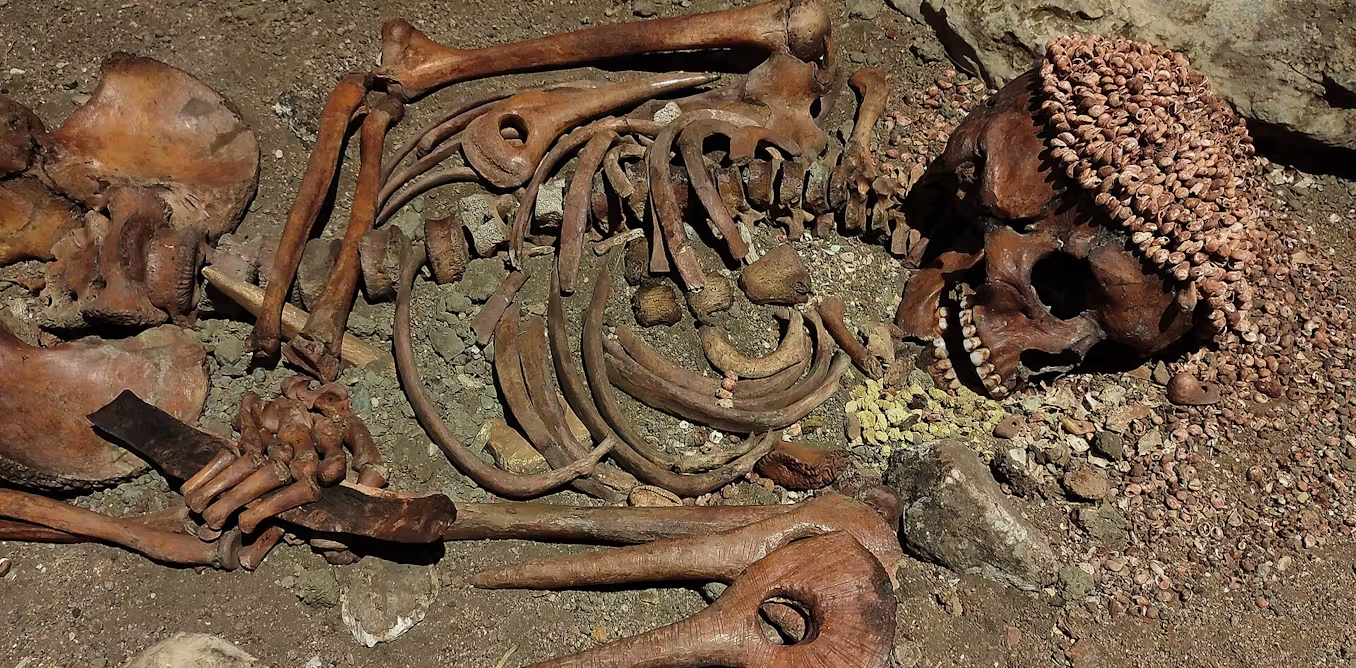
Roughly 27,500 years ago, a 15-year-old boy was brutally mauled by a bear in Arene Candide in today’s Liguria, Italy. The attack tore through his jaw, neck and left shoulder. He was dying, but he was not alone in his final moments.
Instead, his community carried him to a cave, packed his wounds and stayed with him for days until he died. Then they laid him on a bed of red ochre (a natural clay pigment) and buried him.
When archeologists uncovered his remains in May 1942, they found him adorned with hundreds of perforated shells and deer canines forming a cap around his head, mammoth ivory pendants, four decorated elk antler batons and a flint blade still clutched in his right hand — they nicknamed him “il Principe,” or “the Prince.” His lavish burial goods suggested that he either held high status or was deeply revered.
The popular conception of Ice Age life — brutal, isolated, based on “survival of the fittest” — leaves little room for care and grief when it comes to death. Yet the burial of “the Prince” shows how humans have long used objects and rituals to remember their loved ones.
A cave set aside for the dead
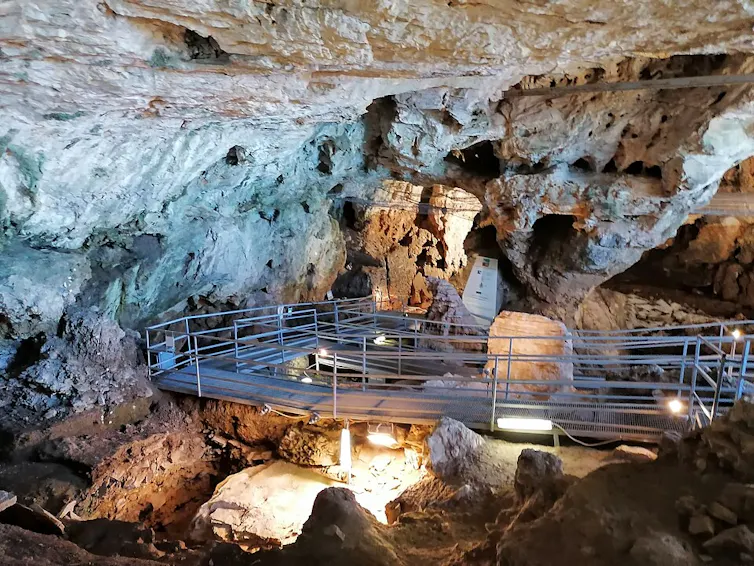
The archeological site of Arene Candide is an excellent example of this behaviour, with multiple burials of this style and cave usage spanning from the Upper Palaeolithic era, 34,400 years ago, all the way through to the Neolithic era, around the sixth century BCE.
Not considered habitable for long periods of time, this cave system seems to have been a designated burial site. This suggests that communities took the time to make their way to Arene Candide in order to prepare and bury members of their family groups.
The community would have brought along ochre. Ground up or used whole, it is believed to have held both medicinal and symbolic roles in the practice of care and death in prehistory.
Ochre can bind to skin, bone and stone, creating durable traces of invested care that survive and remain visible over the years.
Caring for the dying
The injuries sustained by the Ice Age prince were extensive; his skeleton shows damage at the neck, left shoulder and jaw, with pieces of his jawbone and left clavicle missing.
When excavating, archeologists noticed pieces of ochre placed in these wounds as a possible cauterizing agent. With fellow members of the community probably present around the time of the attack, the ochre would have been applied in an attempt to save the teenager’s life.
Using the same pigment for both nursing and funerals reveals a new side of prehistoric life, showing how deeply these early communities valued care and honouring their dead. It suggests a desire to cherish loved ones before and after their death. For a society we tend to imagine as consumed by survival, this is significant.
(Public domain via Wikimedia Commons)
Burying the dead with intention
This burial story at Arene Candide is not the only one of note. At this same site, some 15,000 years after “il Principe” was buried there, a big inhumation — a grave containing multiple corpses — shows a continuation of the practice.
Divided into two separate events, the deposit once again shows individuals buried in red ochre-stained graves. Found with them this time are more than 29 halves of pebbles stained with ochre.
These oblong flat pebbles were all similarly shaped, taken from a beach and were variably stained with the same ochre found in the graves. It is thought that they served as the pigment applicators in the funerary rituals.
Experiments by archeologists determined that these pebbles weren’t broken by accident or as a byproduct of tool making. The clean and even halves pointed to intentional breakage, with one half being left with the buried individuals.
Thought to have been broken as a metaphor for the death of the person, the pebble halves that weren’t left with the bodies were never located. A plausible explanation is that, much like a keepsake, the community held on to the other halves as a way of remembering their deceased.
Read more:
What ancient cultures teach us about grief, mourning and continuity of life
What these burials tell us about grief
These graves show that humans have long found ways to acknowledge the reality of death and to keep bonds alive after it.
The repetition of ochre usage across 15,000 years hints at a deep, culturally ingrained way of thinking about bodies and death. While each passing is a different event, individual stories are merged with ritualistic practices that others can recognize and participate in.
This type of mourning brings communities together around a shared process.
Our ability to use symbolic materials in order to tackle complex emotions, like processing loss, stretches back at least 27,500 years. And although it may not look the same, it may serve the same fundamental purpose of making loss tangible and survivable.

