

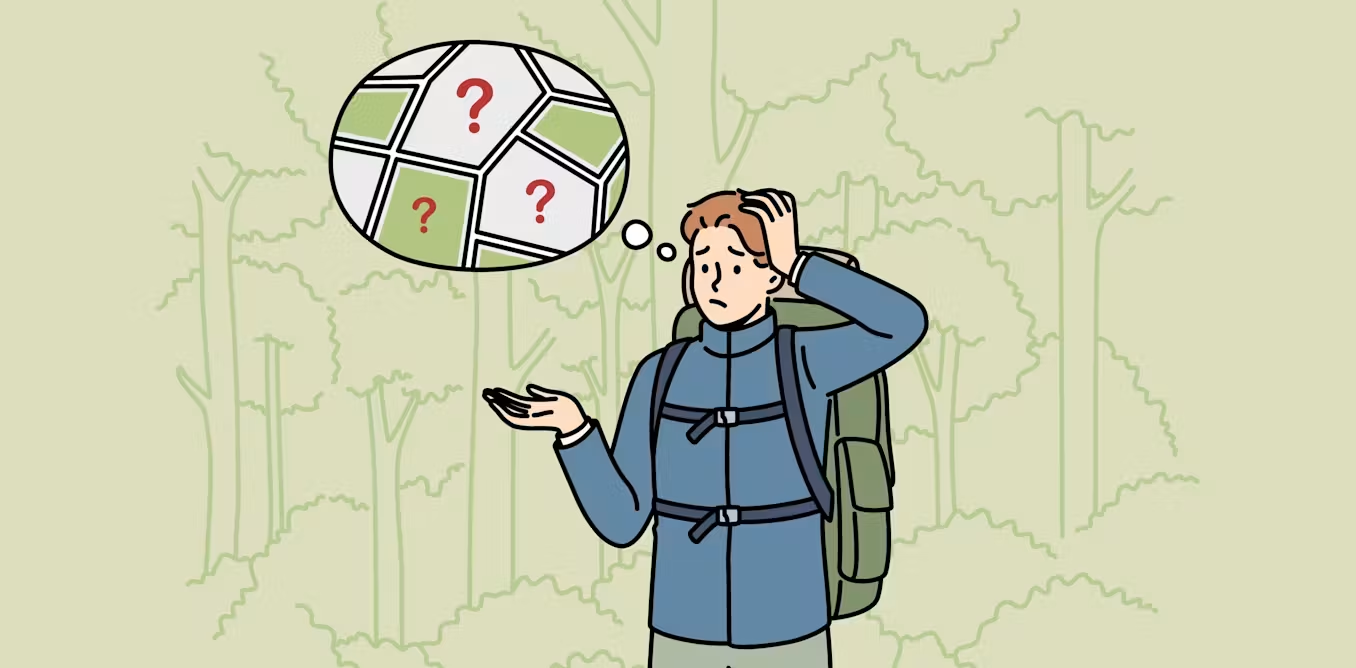
Think about the last time you used your phone to find your way somewhere. What would happen if, halfway through the journey, the route instructions vanished or your phone battery died? You might find yourself starting to panic. But once you notice something familiar or are able to ask someone for directions, this will usually subside, and you can adapt.
For some people, though, this feeling of getting lost doesn’t go away. It can even occur when navigating their own home.
Some estimates suggest up to one in 30 people may be affected by developmental topographical disorientation (DTD). This condition has been described as a lifelong inability to orient oneself – even in extremely familiar surroundings.
People with DTD report getting lost frequently (at least a few times a week) since childhood. DTD is not caused by a brain injury, a neurological disease or a psychiatric condition. As far as researchers can tell, this is just simply how their internal navigation system has always worked.
Early research on DTD focused on the extreme cases in people whose disorientation was disruptive enough that they sought professional help. But we now know there’s substantial variation between cases of DTD. Milder forms may pass by unnoticed across a person’s entire lifetime – quietly written off as merely being “bad with directions”.
Over the past decade, the DTD label has stretched to cover a broad range of navigation problems. The breadth of this label has caused issues of precision, making it difficult to accurately understand and provide support for people living with this experience.
So our research is working to disentangle these navigation impairments. We are focusing on a specific subgroup of people with DTD – those without a cognitive map.
Mapping our world
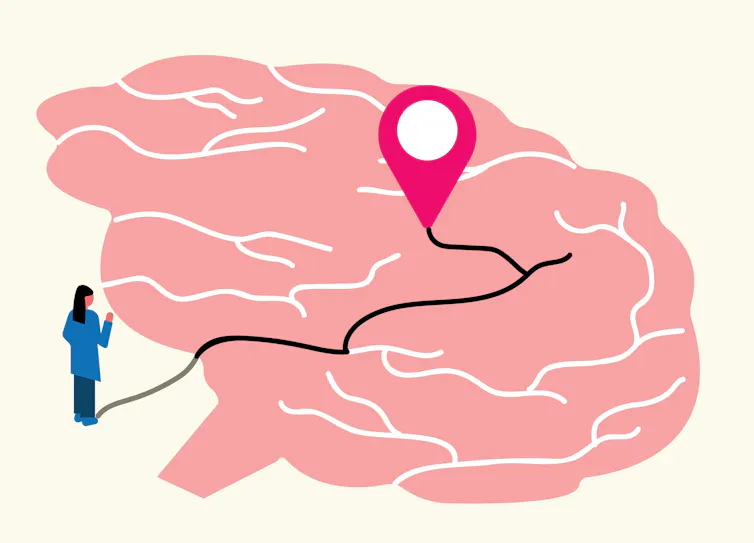
Most of us make sense of our surroundings by building a mental representation of landmarks and where they are in relation to ourselves and each other. This is referred to as our “cognitive map”. It allows us to predict what’s around the corner and get from one place to another without having to think too much about it.
Being able to build and use a cognitive map also allows us to work flexibly in our environment. We can cut across a street we’ve never walked before, or point roughly toward home even when we’re somewhere new.
Working closely with people who have this experience through consultation and qualitative interviews, we propose that this sub-type should be termed “atopia”, which literally means to live without a place or map.
People with atopia do not build a cognitive map of their surroundings. So although they actually have a good landmark memory – the ability to recognise and remember distinctive features of their environment – their overarching cognitive map never quite assembles.
Nanzeeba/ Shutterstock
This means they might know their home is somewhere near the station, and that the shops are somewhere near home – but the pieces stay as separate facts rather than fusing into a single layout they can mentally rise above and read.
So the moment a familiar route is interrupted (a closed road, a wrong turn or approaching a building from an unexpected side) there’s no map to fall back on. The landmarks tell them what they’re looking at, but not how it all fits together.
As one participant we interviewed as part of our research explained: “I am always in one place in my head, so I cannot imagine what my environment looks like.”
When everyday navigation becomes more challenging, it creates a perfect setting for people with atopia to become more rigid, avoid leaving their house or become reliant on GPS devices. This behaviour can be misread as carelessness, anxiety or even low intelligence – which is completely unfounded, but would have significant negative impacts on these people.
Without the right support, people with atopia can quickly lose their independence. For instance, one of our participants would not go anywhere by herself as she relied on her husband whenever she wanted to go anywhere further than a few streets away from their house.
Finding your way
The reassuring part is that atopia and DTD is not degenerative and navigation is more trainable than some people might think.
There’s good evidence that navigation can behave like a muscle. In one study, people who did not exercise their navigation system and relied more heavily on GPS had measurably worse spatial memory when later asked to find their way without it. When the same people were followed over three years, heavier GPS use predicted a steeper decline.
Previous studies have shown that virtual training programmes can be helpful for people with DTD in improving spatial orientation skills. We’re currently testing a similar kind of training to help people with atopia. We developed a six-week virtual programme that aims to reduce navigation complaints and improve navigational skills in people with the condition.
The next time you reach for your phone to follow directions, it might be worth a moment’s pause. Can you still find your way without it? This remarkable ability to find our own way through the world is something many of us take for granted. Maybe we should try to nurture it before it gets lost.

