

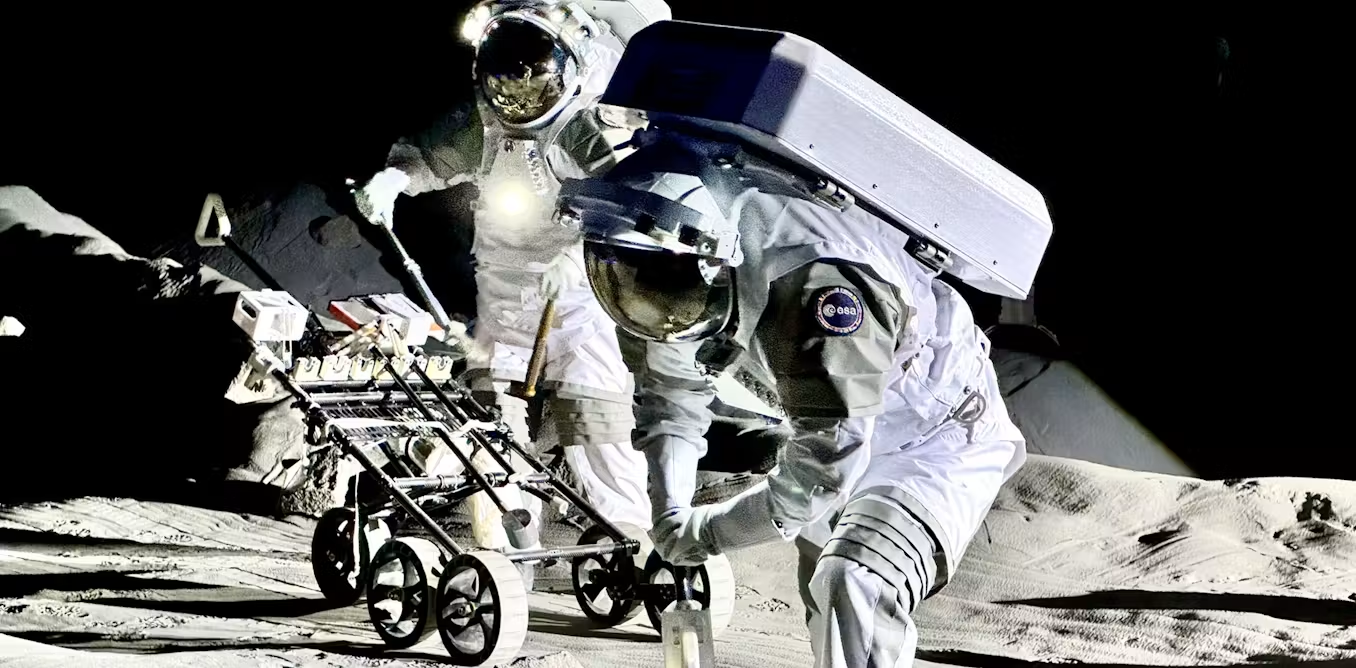
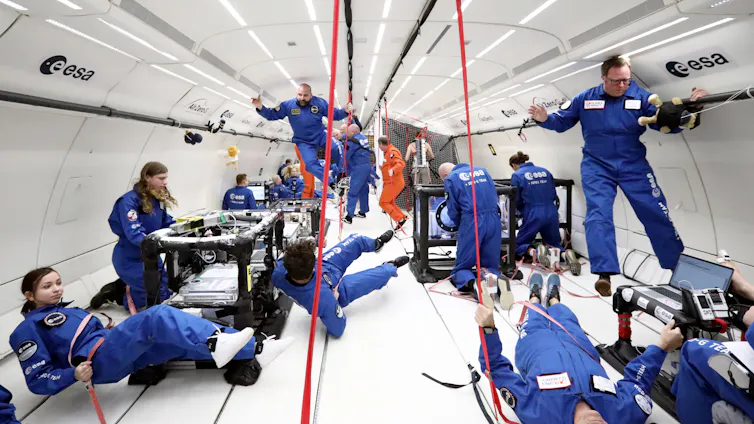
In 2024, I flew on a microgravity, or zero G, parabolic flight with the European Space Agency (ESA). The aeroplane flew big arcs up and down in the sky. At the top of the arc I experienced 22 seconds of weightlessness, just like an astronaut.
On the flight were some of ESA’s newest astronauts, training on the Microgravity Science Glovebox: a see-through box for doing science experiments in space, with gloves to let astronauts use their hands while the box stops the experiment from flying around. I was carrying out research on how to keep astronauts healthy in space.
Piloting us was ESA astronaut Thomas Pesquet, who made floating around look easy: he hung serenely in the cabin while the scientists and trainees crashed about.
My career path to those moments in microgravity looks more like a maze than a straight line. I did an engineering apprenticeship, then an undergraduate degree in physiotherapy, then a Master’s degree in space physiology and health. Finally, a PhD on how to keep astronauts’ backs healthy combined all three.
There is no one way to be an astronaut – you can’t go to astronaut school. You need to pick up skills along the way before applying to be an astronaut candidate. The good news is there are many pathways to becoming an astronaut, or to be floating alongside them, like me.
The Stem and pilot routes
The most obvious and well-known routes are to study science, technology, engineering and mathematics (Stem) subjects, while also becoming a pilot – these paths often intertwine. Exactly which Stem subject, and which kind of flying, counts depends on the space agency or private company you apply to, and on your nationality.
But most of the world’s current astronaut corps took this Stem pathway. Thomas Pesquet is one example: he qualified as an aerospace engineer and a transport pilot before becoming an astronaut candidate in the 2009 class.
The multidisciplinary route
The second, and increasingly common option, is the multidisciplinary route. It includes astronauts who have studied two or more fields that might not seem obviously related to each other, or to spaceflight. Combinations of life sciences and physics are popular, as with Canadian astronaut David Saint-Jacques. He trained as a biomedical engineer, astrophysicist and then as a medical doctor before becoming an astronaut.
©ESA, CC BY-NC
ESA’s John McFall, who was with me on the 2024 parabolic flight, was a Paralympic sprinter and an NHS orthopaedic surgeon before he became an astronaut in 2022. Some combinations are more unusual still: Jessica Meir brought together marine biology and extreme-environment physiology before joining Nasa.
Each of these astronauts offers a unique mix of skills, valued in the complex, problem-solving world of spaceflight. That mix will matter even more on future planetary missions, where one person may need to fill several roles depending on which phase of the mission they are in.
The super-specialist route
The third path is the exact opposite. Instead of going broad, you dive deeply into one topic and become a world-leading expert. For example, ESA’s Sławosz Uznański-Wiśniewski earned two master’s degrees and a doctorate in radiation-tolerant electronics. He then worked at Cern, where he became responsible for the day-to-day running of the Large Hadron Collider, before being selected by ESA in 2022. Sometimes being a specialist
and being really, really good at what you do is itself a pathway to space.
It is worth saying that you don’t always have to decide young. Canadian Jenni Sidey-Gibbons was a combustion engineer and university lecturer before she was selected. Japan’s Makoto Suwa was an earth scientist and senior disaster risk management specialist at the World Bank before he was chosen by the Japan Aerospace Exploration Agency (JAXA) in his forties.
There is no expiry date on the dream, and no single moment when you must decide. It is even fine to stumble along the way. Astronaut Scott Kelly had poor grades at school and failed at least one US Navy exam before becoming an astronaut. He never gave up.
The career path that doesn’t exist yet
Then there is one final route, which none of us knows, because it doesn’t exist yet. When it comes to who they might choose to go into space, commercial spaceflight companies are writing their own rulebooks as they go and are deliberately widening who qualifies as astronauts. We genuinely do not know who the career astronauts of the 2040s will be, or what they will have studied.
However, a strong grounding in mathematics, a science, English and another language is a great start. You will train and live alongside international crews as well as solve problems in space. Whatever you study, your hobbies are the final ingredient. Hobbies make you a rounder, happier, more capable person – the kind of person who makes a interesting crew member.
Get that foundation, do it brilliantly and the rest of what you study is up to you.

