

Government plans for schools in England have set out a vision for inclusive mainstream education. This would see children and young people with special educational needs and disabilities (Send) learning in the same place as their peers without these needs. A central feature of these plans are “inclusion bases”.
Many schools already have spaces that could be called inclusion bases. These include quiet rooms where children and young people can take time out, get extra support, or which provide internal alternative provision, with a distinctive curriculum. They may be spaces which cater for students with specific requirements. This could be around communication or social interaction, for instance.
But the proposed policy calls for an increased number and more formal use of these facilities in primary and secondary schools. It is anticipated that over time every high school and many primary schools will have an inclusion base. They would contribute to the provision of a new special educational needs system. The government has issued new guidance, demonstrating how central inclusion bases are to their vision of inclusive mainstream education for students with Send.
Given the substantial commitment to inclusion bases, it would be reasonable to expect that the evidence for them is compelling. But there is insufficient evidence to show that these bases are the answer to providing inclusive education for children and young people with special educational needs and disabilities.
Hubs for support
The policy proposals include two key types of inclusion base. These match two levels of support for children and young people who require additional help beyond the universal offer. This change is planned as part of earlier intervention in schools.
Children who require additional support beyond what is provided to all pupils at school will receive “targeted” or “targeted plus support”. Support bases are intended for students receiving targeted plus support, and will be funded by schools.
These children and young people who have more complex needs, requiring input from external agencies and professionals, such as speech therapists, educational psychologists or expert teachers, will receive specialist support. Specialist bases would be funded and commissioned by local authorities, and have access to extra expertise provided through a new experts at hand service.
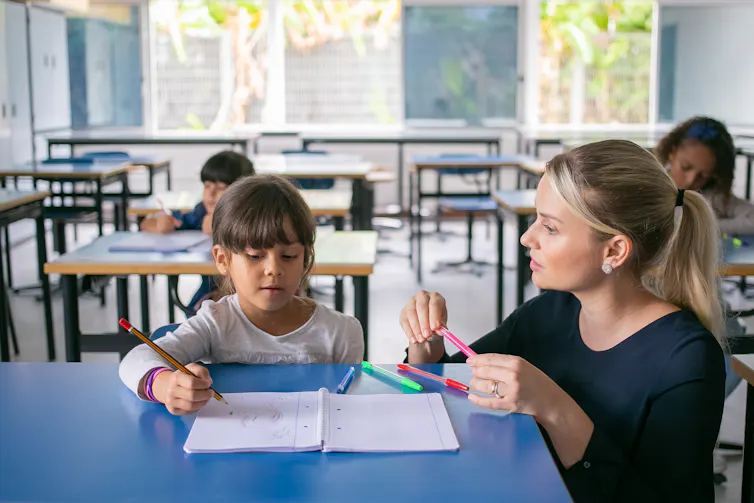
It is clear that the bases are expected to share and adopt best inclusive practice and be a source of knowledge and expertise for other teachers across the school. The hubs are intended to provide a setting in which pupils can learn or receive tailored help for longer or shorter periods, depending on their requirements and how much the young person can access mainstream classrooms.
Mangostar/Shutterstock
They will provide specialist support, even for children and young people with more complex needs, closer to their local communities. It is anticipated that many who would have stopped attending school, been excluded from school or moved into special schools can be supported in these hubs.
But – as the government acknowledges in its recent guidance on inclusion bases – evidence on how effective these spaces are in making schools inclusive is lacking. When analysing Send education using England’s near-universal national student database, we found that data on special educational needs units, resourced provision, pupil support units or internal alternative education is limited and incomplete. We had wanted to investigate the role of the units played across schools, but the lack of data meant this work wasn’t possible.
Mixed results
In previous research with young people, professionals and families of children and young people with special educational needs, Louise Holt and colleagues (Jennifer Lea and Sophie Bowlby) encountered a variety of what the government now labels inclusion bases. We evaluated the impact of one unit, which supported autistic teenagers in accessing a mainstream school. We found that the effect of the unit was mixed.
On one hand, it provided a haven for young people and enabled them to attend a mainstream school, where many of the young people were thriving academically, although less so socially. The base was inclusive and supportive, with well-trained staff, who deployed a variety of inclusive practices.
Yet, simultaneously, the presence of the unit gave mainstream teachers a convenient option to remove young people from their classrooms. Arguably, the presence of the unit did not enhance, and possibly reduced inclusion into the mainstream classrooms.
In other research on this topic, we have encountered many examples of these bases. At best they provide safe spaces. But at worst they can become mini-institutions in which students with special educational needs are no less segregated than those in special schools.
The Department for Education has provided clear guidance about best practice for inclusion bases. Going forward, inspection regimes will change to incorporate inclusiveness. This is critical.
It is vital that the education of children and young people with special educational needs and disabilities is not devolved to new mini-institutions within mainstream schools. Rather, these need to be open, permeable and connected spaces. Inclusion is not about a place. It relies on a set of practices and behaviour that allow for young people to thrive – educationally and socially.
For young people, social aspects of school are often critical, and need to be a key consideration, yet they are often overlooked. Inclusion bases may be part of achieving social as well as educational participation. However, they cannot be the whole picture. More robust evidence is needed both for inclusion bases and for how much mainstream schools and colleges must change to support all children and young people.

