

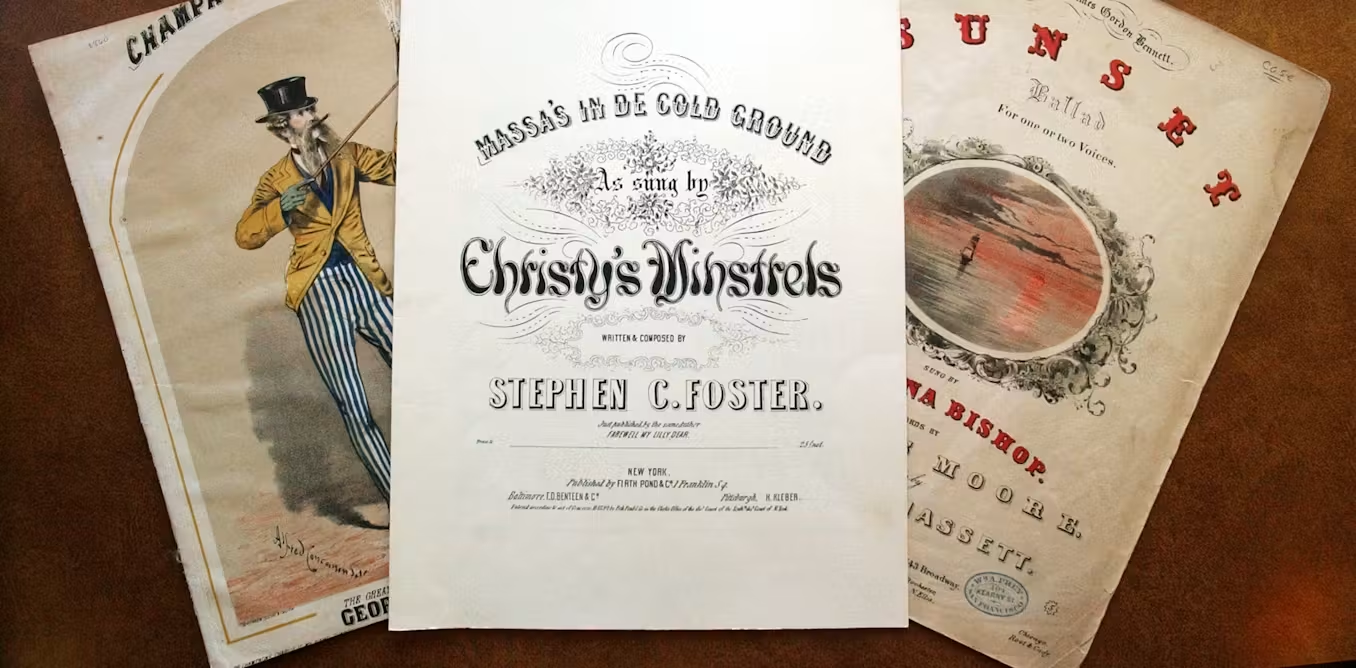
The 250th anniversary of the Declaration of Independence happens to also coincide with the 200th birthday of composer Stephen Collins Foster.
A songwriter who achieved remarkable success in the late 1840s and 1850s with “Oh! Susanna,” “My Old Kentucky Home” and many others, Foster was born near Pittsburgh on July 4, 1826.
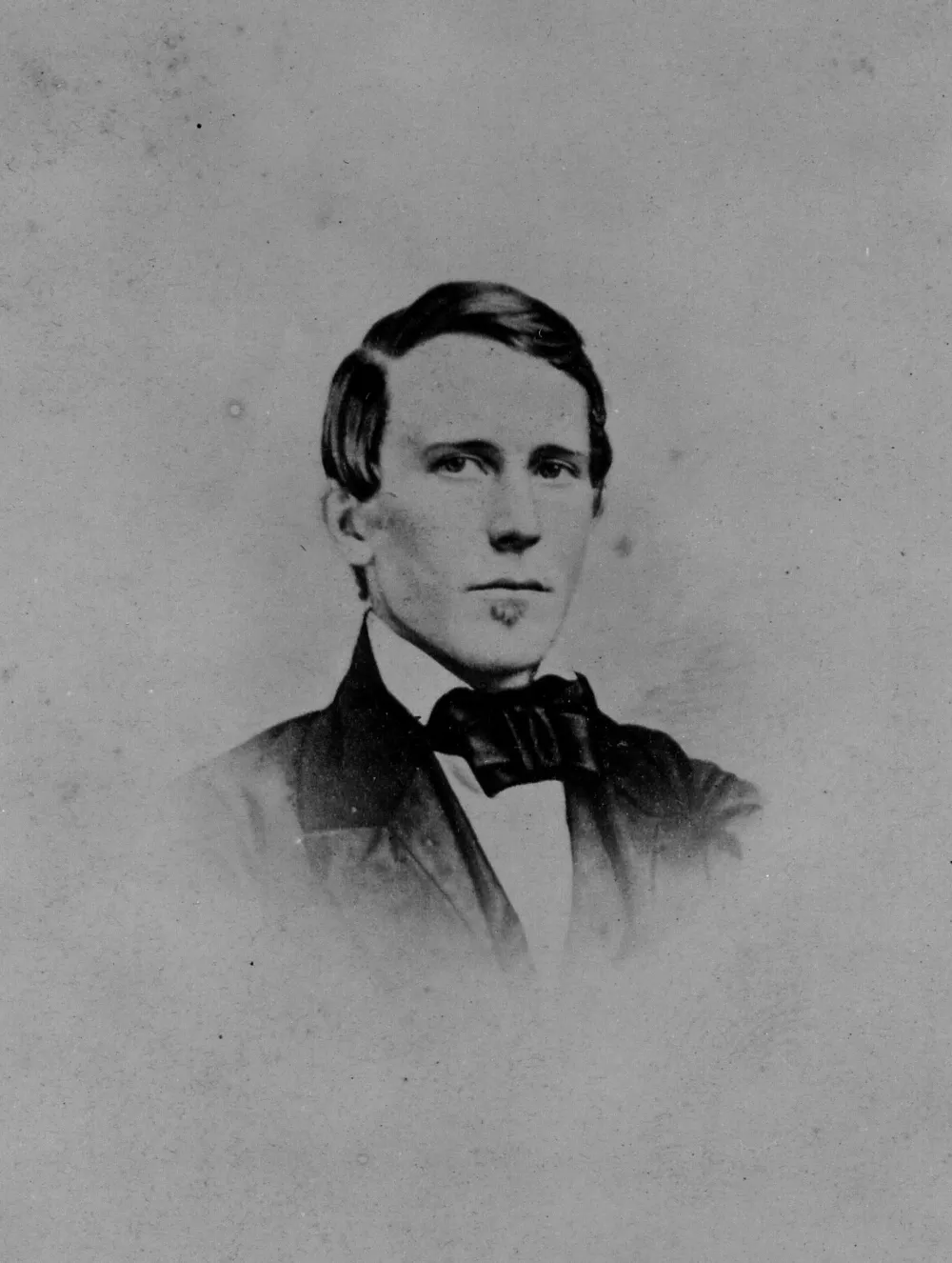
University of Pittsburgh Library System, CC BY-SA
Though he died destitute in 1864, his memory was revived in the 1890s, when he started variously being referred to as “America’s troubadour,” “America’s folk-song composer” and the “father of American music.”
Today, Foster is the only songwriter of his generation with wide name recognition, which owes as much to his music as to his birthday.
Perhaps the primary force behind reviving his memory was his brother Morrison Foster, who published a biography about him in 1896. Drawing on the defining feature of his brother’s songs – their lack of specificity – as well as his brother’s birthday, Morrison positioned Foster as the “founding father” of a vaguely construed brand of racial and cultural progress.
Ambiguity as strategy
A key to understanding Foster’s initial popularity lies in his lyrics, many of which he deliberately crafted to be open to multiple interpretations.
In the plaintive 1854 ballad “Jeanie with the Light Brown Hair,” Jeanie can be understood as dead or simply absent. Similarly, Foster’s “Hard Times Come Again No More,” which he also published in 1854, never specifies what kind of hard times the song refers to. It could be the plight of the working class, disease, war, economic panic or anything else.
Foster and his family were northern Democrats. Like most Democrats at the time, they were aligned with the South, opposed to abolition, and believed that states, rather than the federal government, should decide whether to prohibit chattel slavery.
But for most of his career, when he wrote songs that touched on these issues, he chose not to publish the overtly partisan ones, instead selecting those with open-ended messages.

Sheridan Libraries/Levy/Gado via Getty Images
In one of his biggest hits, “Old Folks at Home,” published in 1851, a formerly enslaved man fondly recollects scenes from his childhood and sings that he is “still longing for the old plantation.”
Foster wrote the song in part for minstrels who wore blackface on stage and dehumanized Black people in their performances. In the decade before the Civil War, proslavery propaganda was rife with false depictions of emancipated people who regretted having been freed. In this context, many proslavery Americans saw the song’s protagonist as longing not just for bygone days but for a return to slavery.
At the same time, some abolitionists saw “Old Folks” as a humanizing portrait of a Black man in an age when racists routinely denied the humanity of Black people. They also appreciated how it depicted the horrors of family separation.
Foster most clearly articulated his personal views in his unpublished campaign songs. For example, he wrote “The White House Chair” for performances under his direction in Pittsburgh in support of the presidential run of James Buchanan, his sister’s brother-in-law. In the song, Foster overtly defends the South’s place in the union:
 Let all our hearts for union be,
 For the North and South are one;
 They've worked together manfully,
 And together they will still work on.
Using unsubtle racial metaphors, he also juxtaposes his Democratic party with the Republicans, whom he claims were influenced by nonvoting- and nonoffice-holding people of color:
 We'll have no dark designing band
 To rule with secret sway;
 We'll give to all a helping hand,
 And be open as the light of day.
In contrast to these partisan and overtly racist lyrics, the ambiguity in his commercial songs was not an accident but a strategy. They were published in the North and South, performed in racist minstrel shows and polite parlors, and sung by abolitionists and defenders of enslavement alike.
By sidestepping the partisan fray in his commercial songs, Foster was able to achieve widespread popularity. His best songs transcended social divisions by enabling listeners to hear whatever specific political or nonpolitical messages they wanted.
In the years before his death, however, popular taste passed him by. During the fevered sectionalism of the Civil War era, his once-sage ambiguity began to appear wishy-washy. His songs promoting national unity failed to catch on.
He died almost penniless in 1864. For decades, his music and his name faded into obscurity.
Morrison’s gambit
Foster’s brother Morrison began working to revive the songwriter’s memory about 30 years after his death.
Morrison was uniquely positioned to do this. Not only had the brothers been very close, but he had also become intimately familiar with Foster’s commercial music, helping him learn how to register compositions for copyright and negotiate publishing contracts. Morrison had even helped finalize the words to “Old Folks at Home.”
By the 1890s, Morrison was also an elder Pittsburgh Democrat with national connections. He worked closely with his friend Thomas Keenan Jr., editor of the Pittsburgh Press, to raise funds for a statue of his brother in their native city. Throughout the fundraising effort, Keenan helped place dozens of articles about Foster in newspapers across the country.
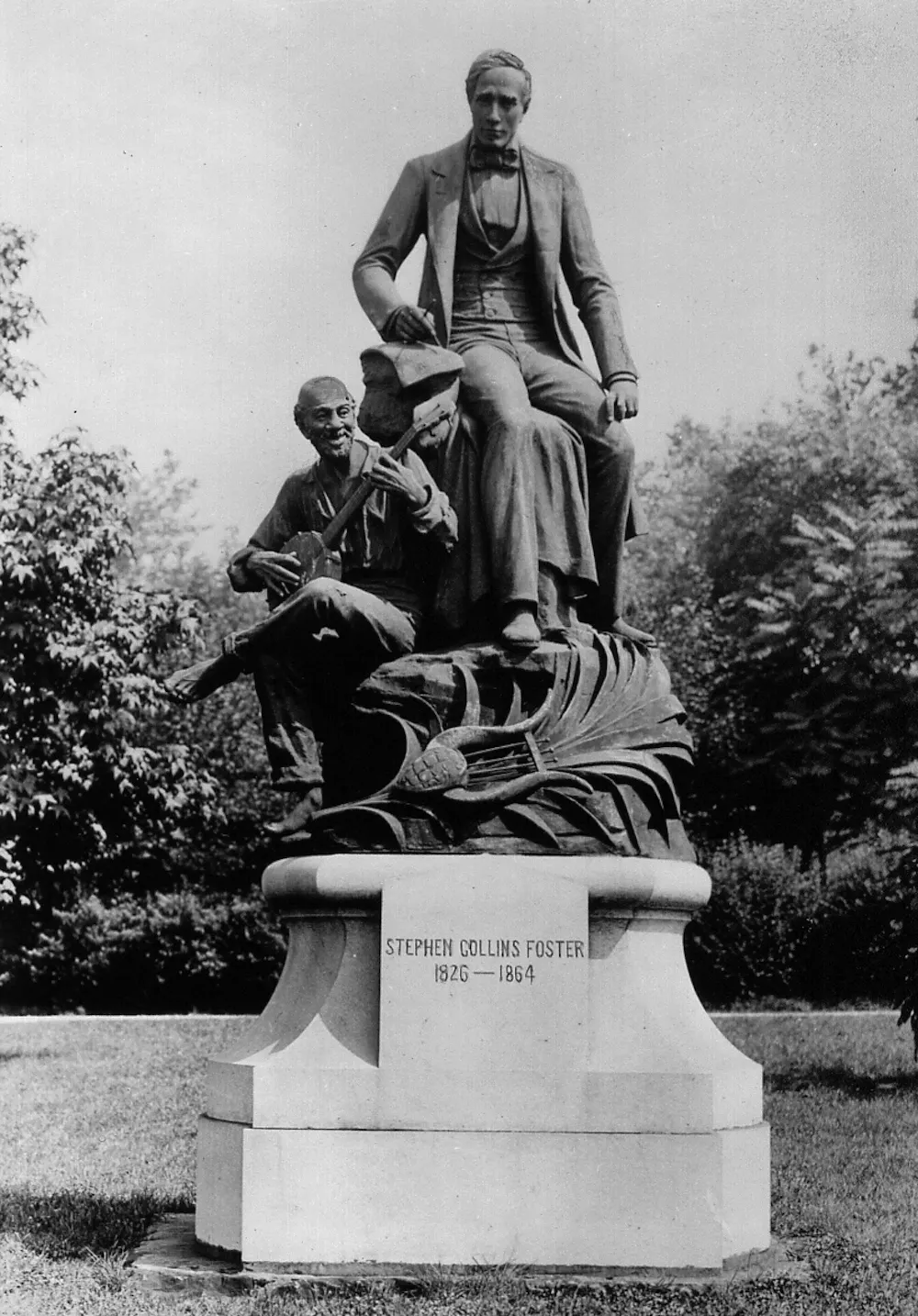
University of Pittsburgh Library System, CC BY-SA
In 1896, Pittsburgh Democrats tapped Morrison as their candidate for his congressional district. Running as a Democrat in a Republican area, Morrison aimed to center his campaign on the theme of unity. He did this, in part, by harnessing the ambiguity of his brother’s songs. It’s no coincidence that his biography of his brother was published just days before the announcement of his candidacy.
Reflecting on the significance of the day his brother was born – July 4, 1826 – Morrison wrote in the biography that it was “a memorable day for several reasons.” Not only had independence “reached its half-century,” but it was also the exact date “Thomas Jefferson and John Adams died.”
With such clever rhetoric – and Keenan’s amplification of it – Morrison convinced generations of Americans that his brother was the “founding father” of a new cultural chapter in American life, one built on the political gains of the previous generation.
In Morrison’s formulation, his brother “founded a new era in melody and ballad” in which “the grotesque and clownish aspect of (minstrel) songs was softened, and ridicule began to merge into sympathy.” According to Morrison, Stephen “opened the way to the hearts of the people, which led to actual interest in the black man.”
Such passages portrayed his brother – and by association, Morrison – as sympathetic toward Black people. Supporters of racial equality appreciated that attitude. But even white supremacists often argued that they sympathized with Black people, while also maintaining that they were superior to them.
Just as Stephen needed a variety of Americans to buy his music, Morrison needed a variety of Americans to cast their votes for him. The vague and broadly appealing concept of “sympathy toward Black people” maximized their popularity among large swaths of 1890s America.
A founding myth, not a founding father
Morrison lost his House race. But in the process, he helped recast his brother not just as an early songwriter who happened to be an American, but also as the first songwriter who channeled a uniquely American voice.
From the 1890s on, countless Americans would sing his brother’s songs at school and church, at public singalongs, around the campfire and, of course, at Fourth of July celebrations.
Foster is more accurately understood as a conservative man and gifted songwriter whose knack for ambiguity resulted in songs both transcendent and controversial. He was fortunate to have a brother who shrewdly transformed the accident of his birthday into a founding myth.
And his late-19th century revival shows that the Fourth of July is not merely a ritual honoring a fixed, national past. It is an ongoing exercise in shaping the nation’s meaning in the present.

