

As the 250th anniversary of American independence approaches, many people in the U.S. are deeply concerned about the country’s future.
A recent poll by Elon University found that 69% of respondents “believe the signers of the Declaration of Independence would feel more disappointment than pride about modern American democracy.” Confidence in public institutions is historically low, and the most recent Harvard Youth Poll indicates that just a quarter of 18- to 29-year-olds “feel hopeful about the future of America.”
Many are also afraid. For the 10th consecutive year, Americans reported corrupt government officials to be their single greatest fear, according to the Chapman University Survey of American Fears, ranking above financial collapse or a loved one becoming seriously ill.
“Americans have come to see threats as not just the possibility of attack by a foreign adversary. The potential for political violence at home is part of it, along with polarization, corruption and a sense of cultural dysfunction,” pollster Kristen Soltis Anderson wrote in The New York Times. “Americans increasingly view the survival of the country as being at stake.”
How are people in the U.S. to make sense of these trends? As Americans celebrate the country’s 250th anniversary, how faithful is the U.S. today to its founding principles? I’m a political philosophy scholar who studies constitutional government. In my view, an especially helpful approach to answering such questions is to revisit the towering but neglected influence of the French philosopher Montesquieu on the founding of this country.
Montesquieu and the American founding
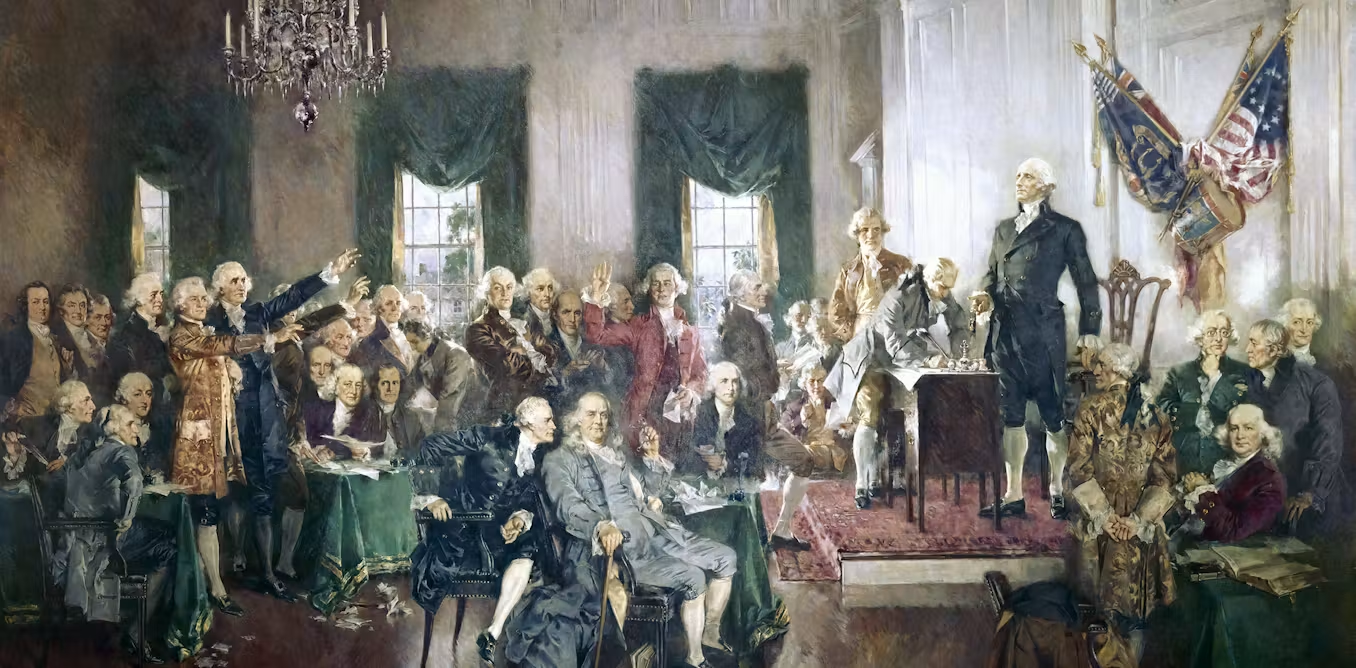
Charles Louis de Secondat, baron de Montesquieu, was an 18th-century philosopher and aristocrat whose book “The Spirit of the Laws” caused a sensation when published in 1748. His ideas shaped the American founders. At the Constitutional Convention, only the Bible was quoted more often.
On the separation of powers, Montesquieu was, in James Madison’s words, “the oracle who is always consulted and cited.” Of all authors cited in political writings published by Americans between 1760 and 1805, none was more frequently mentioned. He loomed so large that “American republican ideologues could recite the central points of Montesquieu’s doctrine as if it had been a catechism,” according to historian Forrest McDonald.
Montesquieu was especially celebrated for his account of how and why political power needs to be separated into branches. But behind this now familiar idea was another that is less remembered: Montesquieu’s theory of liberty inspired the founders’ own understandings of this core concept of American politics.
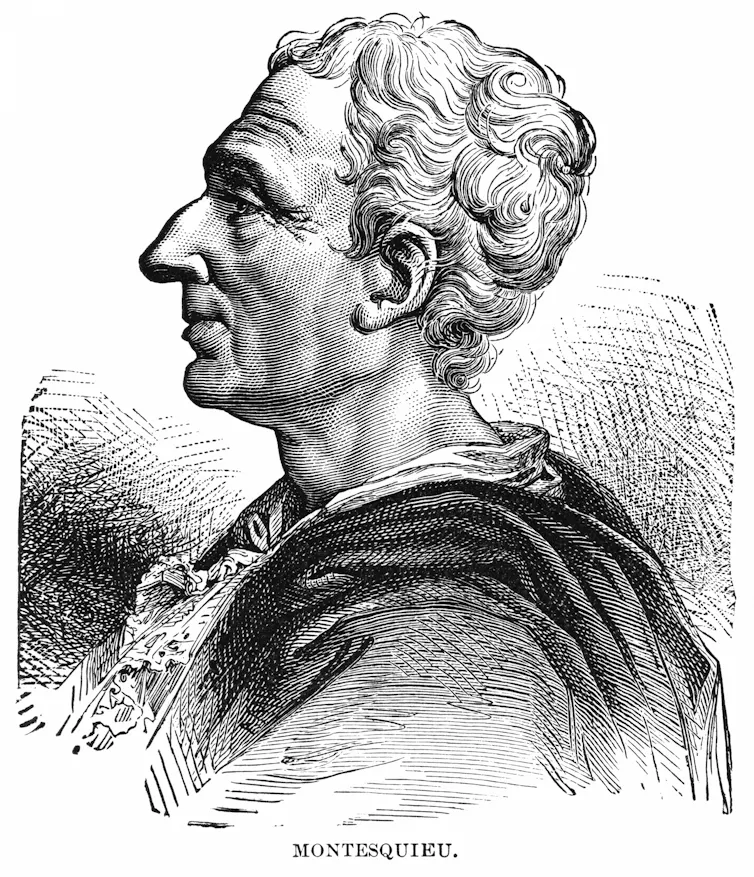
Universal History Archive/Universal Images Group via Getty
A theory of liberty
In “The Spirit of the Laws,” Montesquieu describes political liberty as a “tranquility of mind arising from the opinion each person has of his safety.” To be free is to believe that one is secure. But to believe as much, “it is requisite the government be so constituted as one man need not be afraid of another.”
Liberty cannot be a matter of “doing what one wants,” Montesquieu warns. What if what one person wants threatens others? Then one person’s freedom to act limits everyone else’s. No one can feel secure unless everyone lives under laws that regulate what each may do. Montesquieu understood liberty in terms of this confidence or “tranquility” because it amounts to being free from the arbitrary will of others.
When Montesquieu stresses freedom from fear of other citizens, he doesn’t just mean private individuals. He especially means those acting in a public capacity, like “magistrates” or “rulers.” If public officials’ behavior doesn’t conform to predictable norms set by law, if agents of the government can summarily arrest people, seize their property or revoke their citizenship – say, by denaturalizing and deporting them without due process – it becomes impossible to feel secure.
Even if such actions aren’t directed against me or those like me, such lawlessness is still threatening because it’s unpredictable. I might support the government’s moves against other groups in the moment, but what’s to stop the government from suddenly turning on me when the political winds change?
To prevent public officials from simply doing what they want, Montesquieu famously called for the separation of political power into branches headed by different citizens.
But, he explains, it is not enough that people live under free institutions. They must also believe those institutions to be in the service of their freedom. Liberty, then, is as much a matter of opinion as of fact.
The tyranny of opinion
Montesquieu shows in “The Spirit of the Laws” how the fundamental laws of a country can permit a free way of life even as the country’s cultural norms prevent it. A country might have a free constitution while its citizens believe they hold moral obligations inconsistent with it.
For example, today, Americans might believe that the demands of racial equity or of evangelical Christianity are so pressing that executive power would be justified in ignoring the legislature or the judiciary to serve them.
“In these instances,” Montesquieu writes, “the Constitution will be free by right and not in fact.” The people – or some of them – will experience the law as a hindrance to what they believe they ought or ought not to do.
In such cases, there arises what Montesquieu calls a tyranny “of opinion.” The laws that would otherwise free people from fear of one another and of the government instead inspire a fear all their own. The laws might prevent what some people believe is morally right, or command – in the name of protecting others’ rights or the common good – what others regard as unjust or unholy.
That misalignment between constitutional law and cultural norms makes people feel insecure. It makes the Constitution seem opposed to their will and sense of duty. It can then seem appealing for a leader to promise, in the name of freedom, to ignore the law.
A bracing reminder
In recent years, figures across the political spectrum have called for radical constitutional change – or for ignoring the Constitution outright. There are calls not only to pack the Supreme Court or to ignore its decisions, but also to abolish the Senate and the Electoral College.
From Montesquieu’s perspective, polarization worsens this appetite for disregarding constitutional norms. Each party champions a cultural agenda from which supporters of the other party recoil. Whenever either party is in office, even when it respects constitutional law, its rule can feel to the other side much like the tyranny of opinion Montesquieu describes. The other side’s policies can seem to violate deeply held values, whether it’s banning transgender girls from competing in girls sports or declining to deport immigrants residing in the U.S. illegally.
According to Montesquieu, liberty depends on the kind of civic culture the U.S. seems at risk of losing. No institutions, however well designed, can preserve liberty if citizens believe their preferred cultural norms are so obligatory that political power is needed to enforce them, opposition be damned.
A culture more tolerant of moral disagreements and less quick to reach for political power to force others to accept what they find morally wrong would help ease the distrust many Americans feel toward the government and one another. Until then, Americans will continue drifting away from the liberty that the U.S. was founded to secure.

