

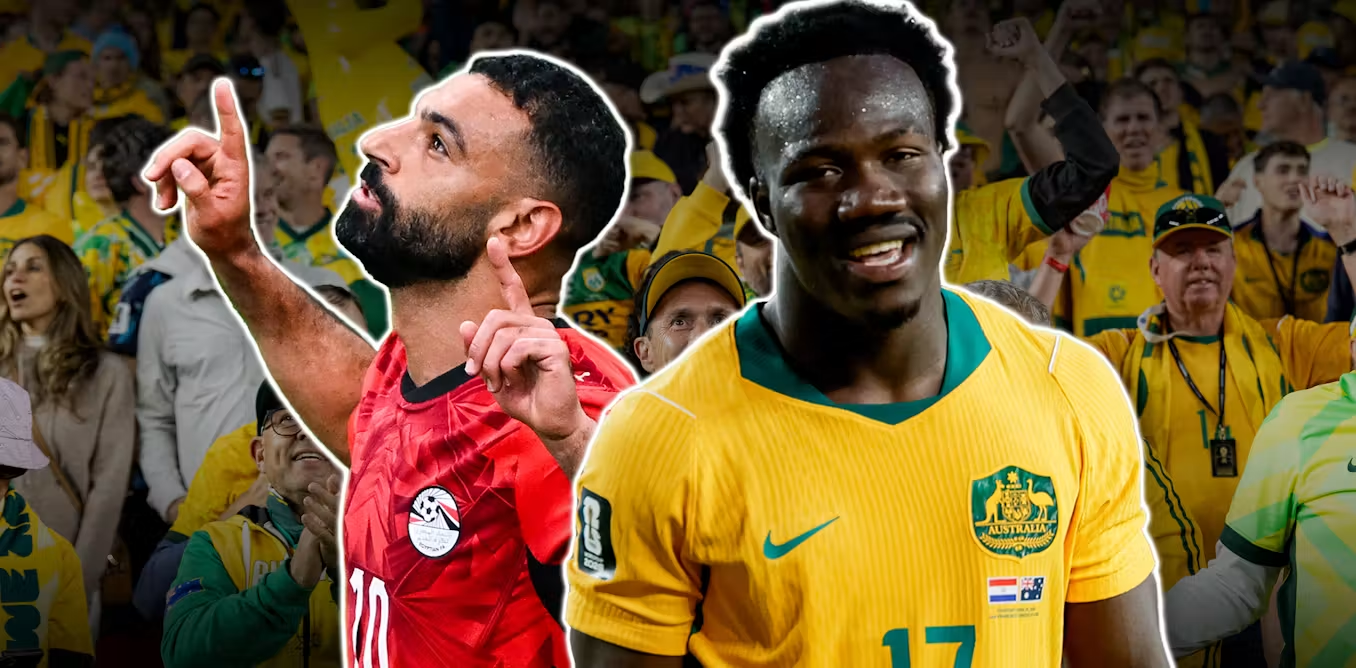
History is possibly only 90 minutes away for the Socceroos as they gear up to face Egypt on Saturday morning (Australian time) in Dallas.
The Socceroos have only made it to a knockout game at a World Cup twice but lost both times.
The Round of 32 clash will be only the third time these two teams have met in senior men’s competition: Egypt beat Australia 3-0 in 2010, and in 1987 the Socceroos beat Egypt in a penalty shoot-out at the President’s Cup in South Korea after a 0-0 stalemate.
So, who are the key players, what tactics will the coaches look to implement, and how may the clash pan out?
Read more:
‘Park the bus’, ‘the false nine’ and ‘total football’: what do soccer’s strange phrases mean?
How did each team get here?
This is the Socceroos’ seventh World Cup: they first appeared in 1974, then returned after a 32-year absence in 2006 and have not missed once since.
But a win against Egypt would be a first knockout-round victory.
The Socceroos qualified from Group D after a promising yet patchy group stage: they surprised many by beating Turkey 2-0, then played poorly to lose 2-0 to the United States, before a 0-0 draw against Paraguay ensured they reached the knockout round.
Egypt is also out to create history. The Pharaohs have qualified for the World Cup four times: 1934, 1990, 2018 and this year. In their previous three appearances, they were eliminated in the first round.
They reached the knockout stage after defeating New Zealand 3–1 and drawing against Iran (1–1) and Belgium (1–1).

Susie Dodds/AAP
Who are the key players in each team?
This Socceroos’ squad is a blend of experience and youth.
Older heads include midfielder Jackson Irvine and defender Harry Souttar, but it’s the exciting, emerging talent that has really caught the eye so far: lightning-quick striker Nestory Irankunda, winger/attacking midfielder Cristian Volpato, Jordan Bos, a dynamic left back, and 18-year-old defender Lucas Herrington, who was the youngest Australian player to start in a World Cup game when he took the field against Paraguay.
The surprise X-factor has been goalkeeper Patrick Beach, who was a shock selection for the first game against Turkey at the age of 20. The A-League local has been outstanding in his debut World Cup.
Read more:
Where do Socceroos come from? Our map reveals Australia’s junior talent hotspots
For Egypt, captain Mohamed Salah is undoubtedly their key playmaker.
A right winger and striker, he has had a legendary career for English Premier League powerhouse Liverpool and will be desperate to transfer that success to his country, as this may be his last World Cup.
However, the 34-year-old is racing the clock to be fit for the Socceroos clash after a reported hamstring injury – he was subbed off in the final group-stage clash.
Other key players are Omar Marmoush, Mahmoud Trezeguet, Ahmed Sayed and goalkeeper Mohamed El Shenawy.
What are the teams’ usual tactics?
Australian coach Tony Popovic primarily focuses on compact defence first with an eye to counterattacking opportunities.
This approach has had mixed success so far, reflected in Australia’s results in the group stage.
His usual formation is either 4-3-3 (four defenders, three midfielders and three up front) or 4-4-2. In defence, Popovic instructs the Socceroos to form a very narrow central shape to close the space near goal, with the wingers dropping back too when needed.
The Pharaohs generally employ a flexible 4-2-3-1 system, adapting their tactical approach based on the opposition.
They played a more attacking style against New Zealand, using width and quick combinations to secure a 3-1 win. Against Belgium, they adopted a compact defensive structure with a focus on counterattacking, earning a disciplined 1-1 draw. Their match against Iran was more balanced and physical, with an emphasis on midfield control and organisation.
Overall, Egypt combines defensive discipline with quick transitions into attack and effective wide play.
What a win – or loss – would mean for the Socceroos
Progressing to the next round would represent a significant step forward for Australian soccer. It would be the strongest men’s World Cup performances in the nation’s history.
Based on the current style under Popovic, this is a realistic objective. The team has developed a clear tactical identity built around a highly organised and compact defensive structure that is difficult to break down.
Regardless of the final outcome, the campaign can already be considered a success. Popovic has implemented a clear culture of discipline, structure and hard work – qualities that strongly align with the traditional identity of the Socceroos.
His leadership approach, which was evident during his time at Perth Glory and other coaching jobs, has translated effectively to the national team.
When Popovic took over in late 2024, there was a noticeable dip in performance, particularly against Asian opponents such as Bahrain, Indonesia and Japan. These matches exposed limitations in both tactical organisation and technical consistency.
However, he has addressed this by introducing a new generation of young players and reshaping the squad. This transition is already producing positive results.
The emergence of this younger cohort, combined with Popovic’s leadership, will be crucial for upcoming competitions such as the Asian Cup in early 2027.
Notably, among Asian nations, only Australia and Japan progressed to the knockout stage of this World Cup, highlighting the significance of the Socceroos’ achievement.

