

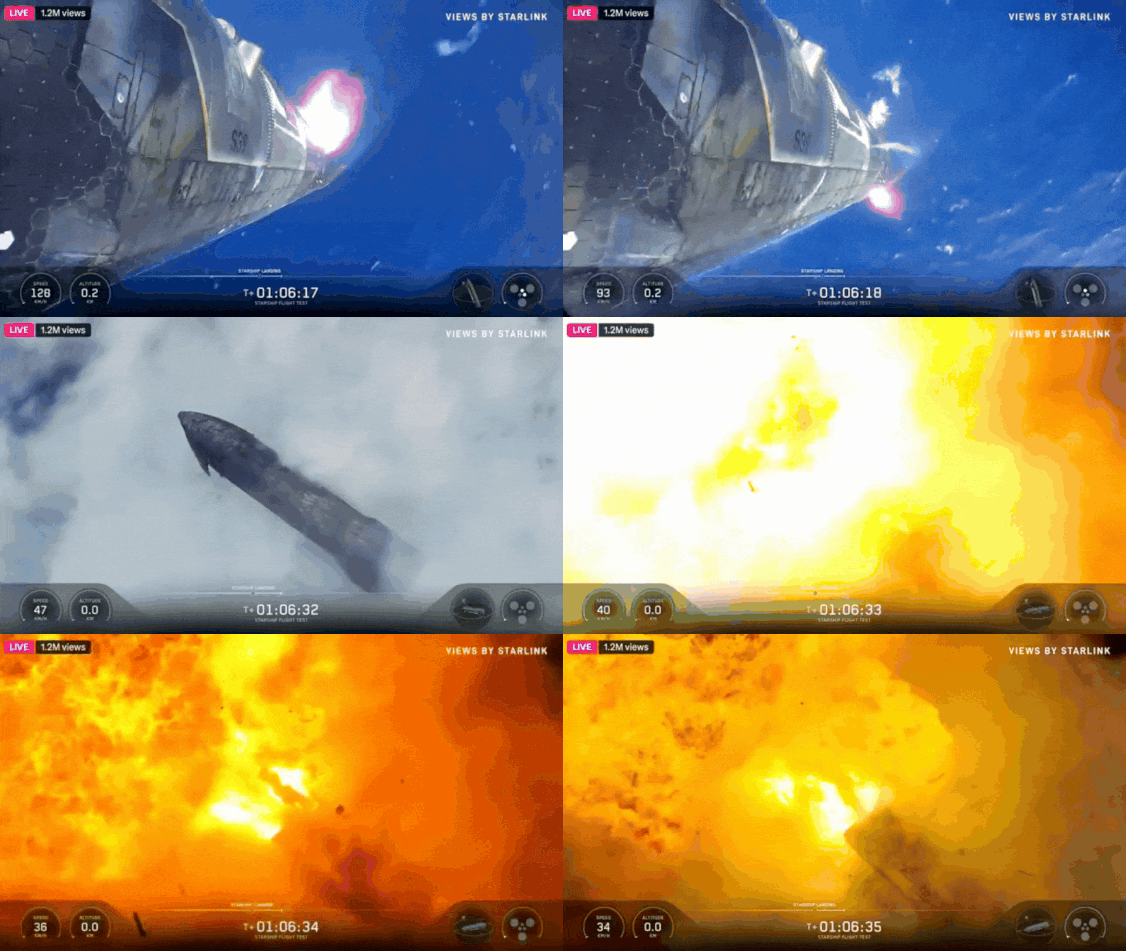
SpaceX’s Starship, humanity’s hopeful chariot to the Moon and Mars, recently concluded its 12th audacious test flight with a dramatic, yet controlled, splashdown in the vast expanse of the Indian Ocean. While headlines might have focused on a visually spectacular “burst into flames” during the final moments, this high-stakes mission was an undeniable leap forward, providing invaluable data for future deep-space endeavors.
The Mission: A Test of Endurance and Innovation
This latest Starship test was far more than a simple launch and land. It was a complex, high-altitude journey designed to push the boundaries of what’s possible in space travel. The colossal spacecraft successfully navigated its ambitious trajectory, demonstrating critical flight capabilities. Crucially, the mission included the deployment of mock satellites, simulating key operational aspects for future cargo and crew missions beyond Earth orbit.
The “fiery” aspect during splashdown, often a result of extreme atmospheric re-entry stresses, controlled fuel burning, or component integrity failure under test conditions, is a critical data point for engineers. In the realm of experimental rocketry, every anomaly, every visual phenomenon, is a treasure trove of information that refines designs and procedures for ultimate safety and reliability.
Navigating Challenges: Engine & Booster Insights
No test flight of this magnitude is without its challenges, and Starship’s 12th outing was no exception. Reports indicated engine malfunctions and a booster issue that emerged during the flight. However, the remarkable achievement lies in the system’s ability to complete its primary objectives and execute a controlled descent despite these hurdles. This resilience speaks volumes about the robust design philosophy and iterative testing approach central to SpaceX’s success. Each anomaly detected is an opportunity for learning and improvement, ensuring that the final operational vehicle is as flawless as possible.
Beyond Earth: Fueling NASA’s Artemis Program and Mars Dreams
The implications of this test flight extend far beyond the Indian Ocean. Starship is not just another rocket; it is central to humanity’s return to the Moon and eventual settlement on Mars. This successful, albeit dramatic, flight significantly advances SpaceX’s pivotal role in NASA’s Artemis program. Starship is slated to serve as the Human Landing System (HLS) for future Artemis missions, tasked with carrying astronauts from lunar orbit down to the Moon’s surface.
Every test brings us closer to a fully reusable, heavy-lift transportation system capable of ferrying vast amounts of cargo and hundreds of people across the solar system. The data gathered from this flight will directly inform the development of Starship versions that will one day carry the first humans to Mars.
SpaceX’s Trajectory: Innovation Amidst IPO Buzz
This critical test flight unfolds amidst growing speculation about a potential Initial Public Offering (IPO) for SpaceX. While the company remains private, the continuous stream of groundbreaking achievements, from Starlink’s global internet constellation to Starship’s ambitious development, fuels investor interest and underscores the company’s immense value and long-term vision. Such successes further cement SpaceX’s position as a dominant force in the rapidly evolving aerospace industry.
Looking Ahead: The Road to Interplanetary Travel
The 12th Starship test flight, with its dramatic splashdown and successful data collection, marks another significant stride on the long and challenging path to making humanity a multi-planetary species. Each launch, each flight, each controlled descent—even those with unexpected visual phenomena—is a testament to engineering prowess and an unwavering commitment to pushing the boundaries of space exploration. The future is being built, one test flight at a time, and Starship continues to lead the charge.

