

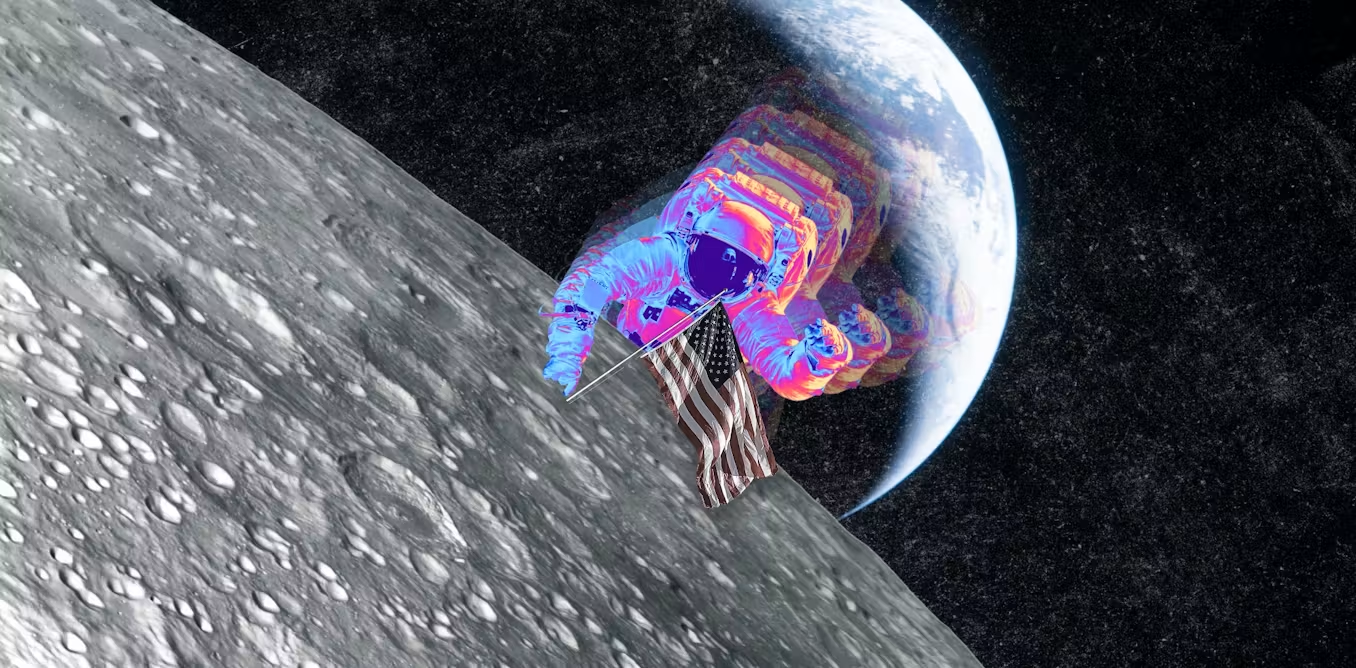
The NASA Artemis program, now supported by 67 countries under the Artemis Accords, plans to return humans to the Moon by 2028. A recent White House Executive Order has gone further, directing NASA to establish a permanent lunar outpost by 2030.
China also has plans to build a lunar base by 2035.
Building the first long-term habitat on another world will push our engineering to its limits. But lunar architecture isn’t just an engineering challenge. At its heart, it is about understanding human experience at the extremes – and how it can help improve conditions for those already living at the edges here on Earth.

The race to the Moon and beyond is accelerating. Some say it’s for the benefit of all humanity. But is it really? In this seven-part series, we explore what our future in space will look like, how we might travel and survive out there, and what’s needed to stop a catastrophe from happening.
The challenge of building a lunar base
Building on the Moon means dealing with the brutal realities of a near-perfect vacuum and unfiltered space radiation. We have some experience with such challenges from orbital habitats like the International Space Station, but there are additional conditions to contend with.
The lunar surface is covered in razor-sharp dust, or regolith, which is abrasive enough to cut through astronaut suits and destroy machinery. And the extreme temperature swings from below -200°C to over +120°C across a lunar day places severe thermal stress on building materials, which expand and contract with every cycle.
Transporting building materials from Earth will be prohibitively expensive, so current solutions focus on using locally available regolith to 3D print monolithic shells. But the lack of atmosphere on the Moon brings another unique challenge.
Micrometeorites rain down like tiny bullets at speeds of up to 72 kilometres per second, easily puncturing structures. A 3D-printed monolithic shell, once damaged, will be difficult to repair.
Our research explores modular block-based construction that can be easily disassembled and repaired by human-robot teams. Our work with colleagues at the NASA funded RETHi facilities at the University of Texas at San Antonio is helping us understand how local damage by micrometeorites effects the whole system, so we can design for repair.

ESA/Foster + Partners
The challenge of living on a lunar base
Lunar architecture is not just about survival. It gives us the chance to ask what it means to actually live in extreme conditions, and what that reveals about human experience more broadly.
For instance, what happens when people have to spend long periods in isolation or confined spaces, with no opportunity to step outside? This is not unique to space. Many of us experienced this during COVID, and others live it routinely on submarines, mining outposts and Antarctic stations.
Research shows that most people in such conditions describe time as feeling distorted, leading to higher stress and reduced social satisfaction. When days become repetitive and monotonous, and the future feels uncertain, time stops being meaningful.
Drawing on design psychology, we work with people who have lived or worked in isolated and confined conditions to understand how design can help. Small details – a private space to retreat to, lighting adjusted to personal rhythm, a window with a view – can have a considerable impact on emotional wellbeing and morale.
The psychological toll of living in extreme environments is inseparable from its physical demands. How do we keep the human body operating safely in these extreme conditions, and what happens when someone is injured far from help?
Again, this is not unique to space. Biomechanics research already helps us understand how joints and muscles move, preventing workplace injuries and supporting rehabilitation. But strip away Earth’s gravity, and everyday movements, like climbing a flight of stairs, reveal something new about how the body really works.
Our research uses gravity-offload experiments to study how the arms, shoulders and torso work together to lift and stabilise the body as gravity changes. The findings can inform the design of stairs and handrails for lunar habitats, making movement more efficient and preventing injury.

NASA
What this means for life on Earth
The construction industry accounts for roughly half of all global material extraction and around 30% of waste and carbon dioxide emissions – much of it because buildings are demolished rather than repaired.
The repairability and human-robot collaboration principles we are developing for lunar architecture offer a model for circular construction here on Earth, where maintaining buildings rather than tearing them down could transform the industry’s environmental footprint.
Our research on the psychology of isolation can also improve life for people stationed at polar research bases, in remote communities, or even in prison. And our biomechanics research, focusing on how forces redistribute between the upper and lower body, can help older people to climb stairs more safely, avoid falls and recover from injury.
Lunar architecture research is not about a distant, futuristic idea. It is about understanding human experience at the extremes, and using that understanding to ask better questions about how we design for people here on Earth. Humanity already lives at the edges. Learning to design for those edge conditions can teach us how to dwell more inclusively on this planet, and beyond.

