

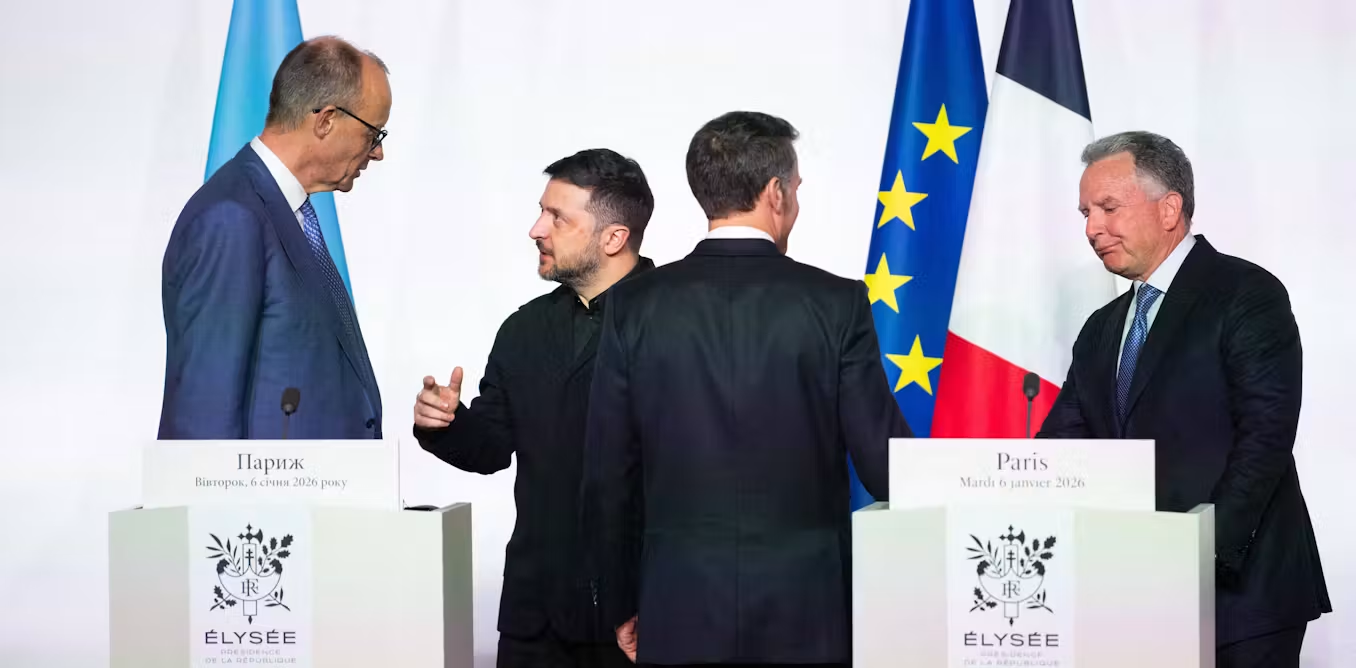
The G7 summit at Evian from June 15 to 17 is most revealing not for what was agreed, but for what was exposed about the state of play among Europeans, and their relationship with the US. For all the choreography and displays of unity, the summit was, in large part, theatre. It was an attempt to paper over what is becoming increasingly obvious: many of the most critical international issues are now decided without the EU. Brussels is now, at best, an informed bystander.
This was obvious when the US president, Donald Trump, signed a physical copy of his deal with Iran at a post-G7 dinner at the Palace of Versailles hosted by Emmanuel Macron. It was a diplomatic coup for France, rather than a plan hatched by the EU.
The G7 produced nine joint declarations and seemingly reaffirmed more than just the bare minimum of western unity that has been possible of late. The leaders’ statement on geopolitical issues included strong language on Ukraine. The G7 promised “to increase the delivery of air defence capacities, additional systems and interceptors, and long-range capabilities” and “to increase the pressure on the Russian war economy”.
Yet, it fell short on concrete provisions and timelines. And it notably lacked the commitment to the “robust and legally binding security guarantees” and “the deployment of the Multinational Force – Ukraine” that France, Germany and the UK (the “E3”) had emphasised in their joint declaration with Ukraine’s president, Volodymyr Zelensky on June 7.
The E3 and Ukraine mini-summit showed European diplomatic coordination at its most effective. Évian, by contrast, showed how little of that coordination carries into the decisions that ultimately matter.
Europe’s struggle for relevance is also obvious in relation to Ukraine. The last meaningful – if hardly constructive – negotiations occurred in the so-called “Geneva track” in February. Mediated by Trump’s Witkoff-Kushner team (which was also involved in talks with Iran), this brought Russia and Ukraine together for talks.
But while Washington reported “meaningful progress”, Zelensky commented that “sensitive political matters … have not yet been sufficiently addressed” and called for European to be involved in the next round of talks. This has not happened.
Meanwhile, Europe’s own efforts also failed. Putin immediately rejected the call from E3 and Ukraine for direct talks. This was reinforced in a June 19 essay penned by Russia’s foreign minister, Sergey Lavrov, accusing Europe of complicity in the 2014 political crisis in Ukraine which ousted the pro-Russian president, Viktor Yanukovych, and precipitated the conflict. He added they had sabotaged any attempts at peace.
But the EU was already at loggerheads with itself. Earlier that day, EU leaders gathering for a summit in Brussels discovered that António Costa, the European Council president, had instructed his office to reach out to the Kremlin — without consulting member states — to lay the groundwork for potential peace negotiations with Russia over Ukraine. Their reaction ranged from surprise to outrage. Germany’s chancellor, Friedrich Merz, and Macron both publicly pushed back against Costa. Macron stated that “he [Costa] cannot represent [EU states] when security guarantees are at stake”.
The episode was damaging for reasons that go well beyond procedural embarrassment. The spectacle of European leaders publicly repudiating their own council president will have given Moscow the satisfaction of knowing that Europe still cannot speak with a single voice.
The European Commission president, Ursula von der Leyen, tried to bring the message under control. At her press conference after the EU leaders’ summit, she noted that “sooner or later Russia will need to come to the negotiating table, and when that comes we need a united European message to President Putin”. That ambition, however, contrasts sharply with the reality of the earlier Costa episode.
A unified approach
Diplomatic embarrassment is not the only issue when it comes to how quickly Europe will be able to close the persistent gap between ambition and reality.
On June 8, the German government formalised its withdrawal from the Future Combat Air System (FCAS), the €100 billion (£86 billion) joint fighter jet project launched in 2017 as the flagship expression of Franco-German defence ambition. FCAS also included engines, sensors and a digital intelligence network known as “combat cloud”.
One point of contention was reportedly the leadership role played by French aerospace giant Dassault. Germany wanted more of a leadership role and the partners are reported to have had divergent visions of the end product.
Germany’s aspiration to “lead or substantially shape” future European air combat systems may seem rational given the country’s financial muscle and engineering prowess. With more than €750 billion committed to rebuilding its armed forces by 2030, Germany’s instinct that this investment should produce proportionate industrial and strategic leadership is understandable. But when applied to European defence cooperation, it is counterproductive.
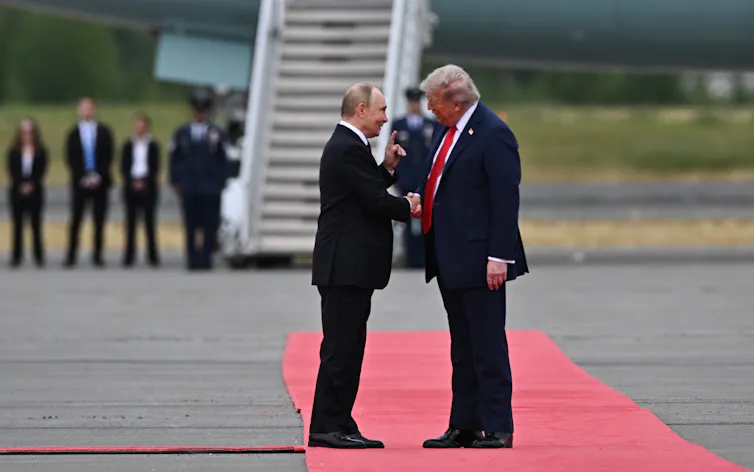
EPA/Sergey Bobylev/Sputnik/Kremlin pool
While European states, including Germany, have repeatedly stressed the need for collective action on defence, there is a repeated fallback on national initiatives. It’s hard to escape the conclusion that Europe continues to struggle to effectively coordinate efforts.
In a development that neatly illustrates this point, on June 20 the UK unveiled three prototype long-range strike missiles built without any US-manufactured components. The product of an 18-month programme known as Project Brakestop, the explicit purpose of developing this capability is to remove Washington’s ability to veto their deployment in Ukraine.
On the positive side, the UK’s ability to pull this off is commendable. It encapsulates the transformation in European thinking about the transatlantic relationship under Trump – and the capability to follow through on this.
But as an act of strengthening European strategic sovereignty, it falls short. It is British rather than European.
Europe’s ambition to rise to the simultaneous challenges of Trump’s transactionalism and Putin’s adventurism has been stated loudly and clearly on more than one occasion over the past 18 months or so. This ambition is most commonly expressed in the quest for strategic autonomy or “going it alone”. But it is not matched with an ability to act coherently.

