

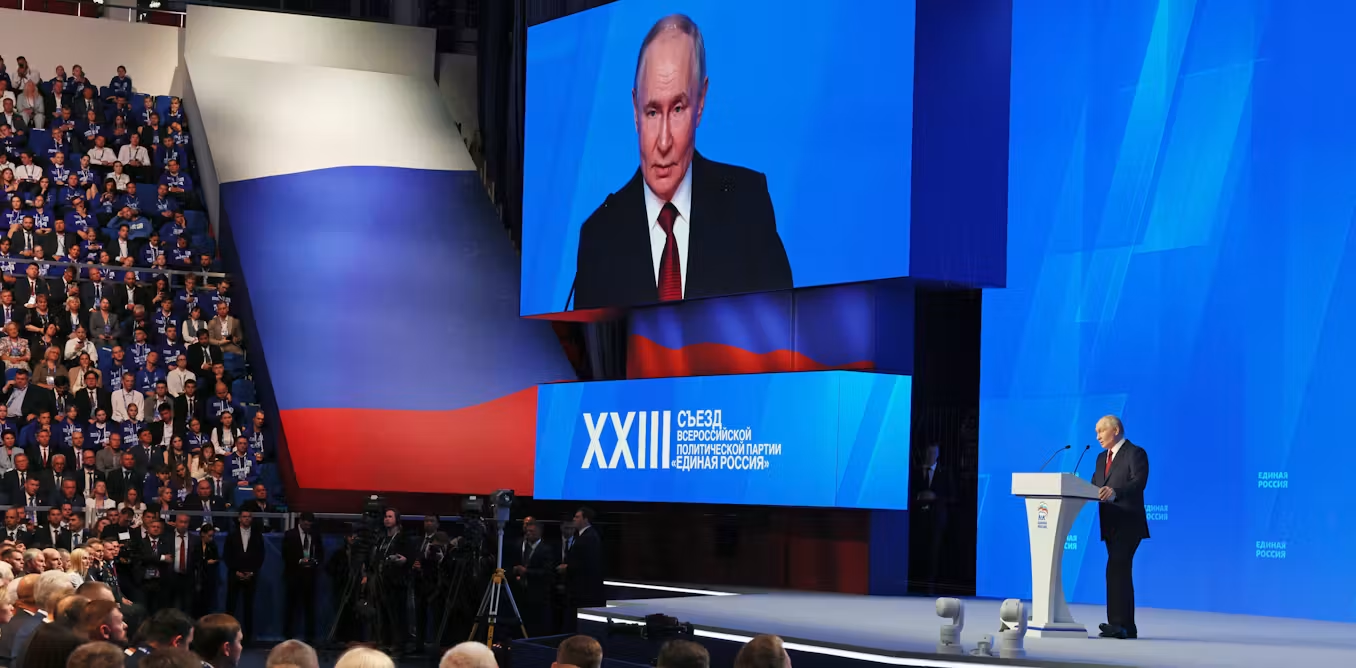
Vladimir Putin has finally acknowledged that Ukraine’s relentless drone attacks on Russia’s energy infrastructure are having an effect.
Speaking to the ruling United Russia party on June 28, the Russian president confirmed that his country is facing “a certain shortage” of fuel and that “strikes on our infrastructure sites are creating problems”.
In fact, the situation is far worse that Putin admits.
Russia has hit back hard at Kyiv and other cities in Ukraine, launching massive strikes over night on July 1 with a combination of drones as well as cruise and ballistic missiles, killing at least 17 people and injuring dozens more.
Ukraine’s president, Volodymyr Zelensky, had warned that the Kremlin was planning another massive attack in retaliation after a month in which a Ukrainian air offensive has put considerable pressure on Russian defences and morale.
Throughout June, Ukraine stepped up its strikes on Russia’s energy infrastructure deep in the heart of European Russia, far from the front lines of the war in eastern Ukraine. Oil refineries in Moscow itself have been hit. All regions of Russia now report fuel shortages and knock-on effects are emerging with delays in the delivery of food and other goods.
Russian-occupied Crimea has been a particular target, with regional authorities declaring a state of emergency on June 26 amid power outages, food shortages and fuel rationing that includes banning the sale of petrol to civilians.
Crimea has been a focal point for Ukraine’s strategy in part because it has played a vital role in Russia’s war effort. It has been an important route for military equipment and supplies heading to the combat zone in Ukraine’s Donbas region. Control of the port of Sevastopol provides Russia with a foothold in the Black Sea, even though around 30% of the vessels in Russia’s Black Sea fleet have been damaged or destroyed by Ukraine since 2022 and large parts of the fleet were relocated further east in 2023 under pressure from Ukrainian strikes.
Even the remaining command and control units are now believed to be planning to pack up and move to Russia.
But Ukraine has also focused its attention on Crimea as a target because of its symbolic significance as the “jewel in the crown” of Russia’s campaign in Ukraine. Ever since Russia annexed Crimea in 2014, the peninsula has been used by Moscow as a symbol of the success – and indeed the righteousness – of its efforts to claim Ukrainian territory as its own. The fact that Russia has been unable to protect Crimea from Ukrainian strikes is therefore particularly humiliating for Moscow.
‘Crimea is ours’
The 2014 operation to seize control of Crimea was carried out very efficiently by Russian troops who swiftly occupied key strategic points. Ukrainian and western media labelled the soldiers “little green men” and initially Putin claimed they were “local self-defence units.”
It was later revealed they were Russian troops – and among pro-Russia residents of Crimea they were seen as heroes. Their professional appearance and disciplined behaviour gave Russians a reason to be proud of their armed forces, which had a reputation for brutality and incompetence. Locals flocked to take selfies with them.
The annexation sparked a surge of nationalist sentiment in Russia. The phrase “Crimea is ours” became a social media meme and was was printed on consumer goods.

EPA/Sergei Ilnitsky
The Russian film industry was enlisted to reinforce the message. The 2017 blockbuster “Crimea” – made with funding from Russia’s defence ministry – presented the annexation as a demonstration of the country’s status as a great power. The following year, a feel-good romantic comedy Crimean Bridge – Made with Love! was released. Written by Margarita Simonyan, the head of the Russian news outlet RT and a close ally of Putin, it depicted life in the peninsula as a sun-drenched adventure.
While popular culture painted an attractive picture of Crimea, Moscow encouraged Russians not only to spend their holidays there but to take up residence to ensure another, more permanent, form of occupation. As many as 200,000 Russians are believed to have relocated to the peninsula, lured by the warmer climate and the promise of jobs and generous welfare benefits.
Russia struggling to adapt
Moscow’s failure to shield Russian society from the impact of war exposes the myth of Putin’s repeated claims that the war is proceeding according to plan. Even the US president, Donald Trump, who famously told Zelensky in early 2025 that Kyiv did not hold any cards in this conflict, has reportedly acknowledged that Ukraine is “doing pretty well”.
This raises the question of what Russia might do to try to regain the momentum. The mass invasion stage of Russia’s war in Ukraine since 2022 has revealed some clear patterns. Whereas Ukraine has been good at innovating in weapons development and in strategy and tactics, Russia has been slow to adapt to change.
In the short term, Moscow responds to setbacks by intensifying its attacks on civilians in Ukraine, as we have seen with the massive overnight strikes on July 1.

AP Photo/Danylo Antoniuk
In the medium term, Russia adapts its tactics. For example, responding to Ukraine’s ability to strike large formations of troops on the front lines by dispatching a handful of soldiers at a time, sometimes on horseback, to continue Russia’s advance.
This suggests that we are likely to see continuity rather than radical change in Russia’s approach to this war – for example, putting more emphasis on anti-drone and anti-missile measures. But there are real doubts about whether Russia’s thinly-stretched defences can provide effective protection for the wide range of locations that Ukraine targets.
It is too soon to say whether the tide of the war has turned in Ukraine’s favour. But unless Russia finds a more robust response to the challenges it faces from Ukraine, we may look back on June 2026 as a decisive point in this conflict.

