

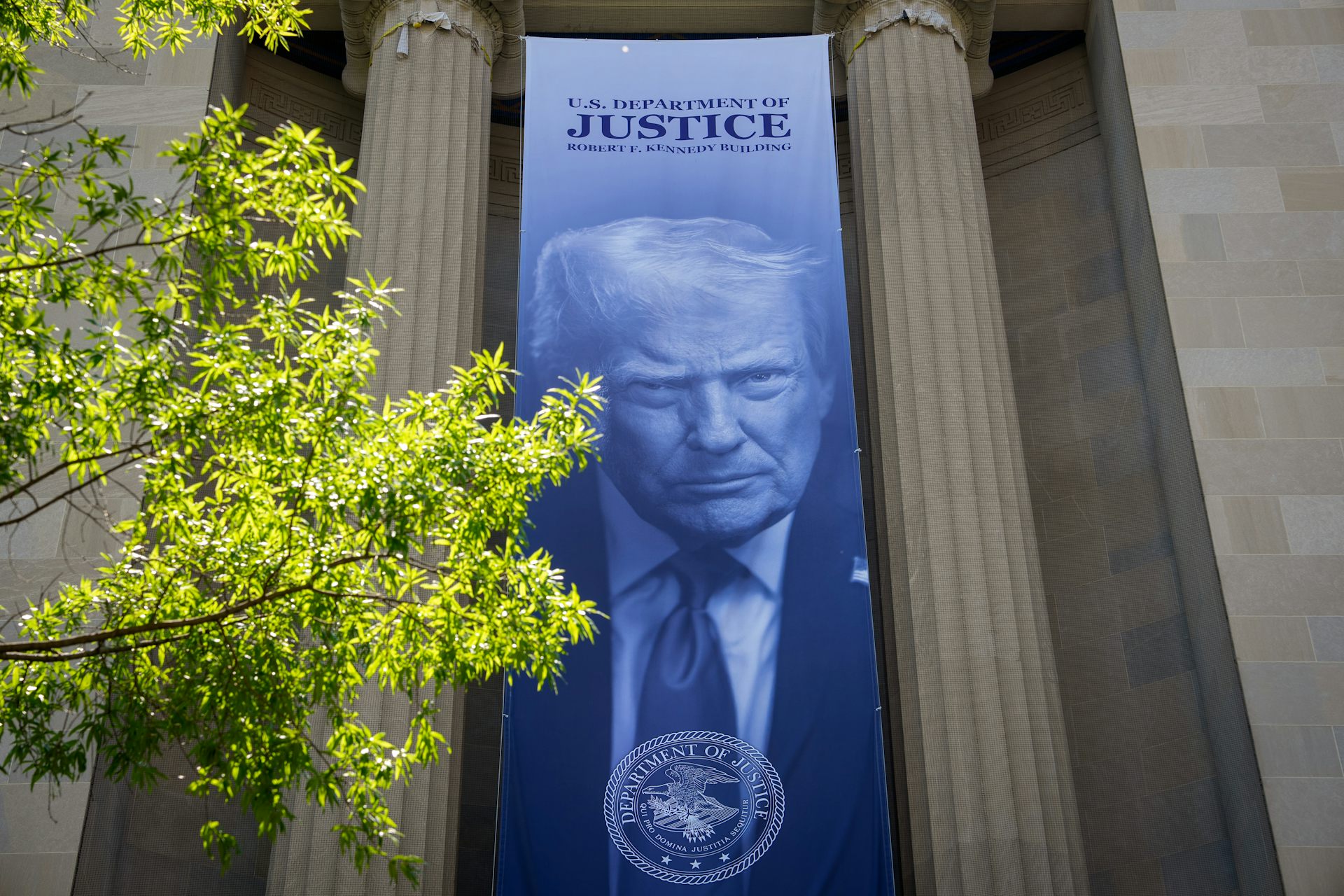
A banner featuring President Trump on the outside of the DOJ building in Washington, D.C. Andrew Harnik/Getty Images
America’s $1.776 Billion Bombshell: Is Justice for Sale, or Just Weaponized?
Imagine a world where the very institution meant to uphold justice establishes a fund to compensate those who claim they were politically targeted. Now, imagine that fund, established by one administration, might benefit the very leader who put it in place. Sound like a plot from a political thriller? Welcome to the unfolding reality of the U.S. Department of Justice’s new “Anti-Weaponization Fund.”
This isn’t just another headline; it’s a seismic event that’s shaking the foundations of American political morality and constitutional law. From the wisdom of ancient philosophers to the architects of our republic, voices across millennia are whispering their warnings about the dangers of a judge in their own cause. And the stakes? A colossal $1.776 billion of taxpayer money, and potentially, the integrity of our justice system.
Let’s dive deep into this unprecedented development, dissecting the claims, the controversies, and the chilling historical echoes.
The Anti-Weaponization Fund: A Closer Look at the $1.776 Billion Payout
On May 20, 2026, the Trump administration dropped a bombshell: the creation of a US$1.776 billion “Anti-Weaponization Fund” within the Department of Justice. Its stated purpose? To “allow people who believe they were targeted for prosecution for political purposes, including by the Biden administration Justice Department, to apply for payouts.”
Acting Attorney General Todd Blanche hailed it as “a lawful process for victims of lawfare and weaponization to be heard and seek redress.” But the alarm bells rang immediately. Critics wasted no time pointing out the elephant in the room: could this fund be used to compensate individuals involved in—or even convicted for—the Jan. 6, 2021, attack on the Capitol? Blanche has conspicuously refused to rule out that possibility.
This colossal fund didn’t materialize out of thin air. It’s part of a settlement agreement that saw President Donald Trump drop his massive $10 billion lawsuit against the Internal Revenue Service. Trump’s suit alleged that leaks of his tax returns caused “reputational and financial harm, public embarrassment, unfairly tarnished their business reputations, portrayed them in a false light, and negatively affected President Trump.” In essence, the DOJ, under Trump’s executive control, settled a lawsuit filed by Trump himself, creating a fund that could benefit his allies.
The fund, slated to cease processing claims by Dec. 1, 2028, will provide “formal apologies and monetary relief” and be overseen by a five-person board appointed—and removable—by the Attorney General and President, respectively. The appearance of self-dealing isn’t just “unavoidable”; it’s a glaring centerpiece of this entire saga.
When Philosophers Warn: “No One Should Be a Judge in Their Own Cause”
To truly grasp the gravity of this situation, we must journey back in time. Long before our modern political skirmishes, ancient thinkers and the architects of our own nation warned against a fundamental flaw in human nature: the irresistible urge for self-preservation and personal interest.
Thomas Hobbes, the great political theorist who penned “Leviathan” during the English Civil War, had a notoriously dim view of rebels. He believed insurrectionists forfeited their citizenship and should never be rewarded. One can only imagine his reaction to a fund potentially compensating those involved in the Jan. 6 Capitol attack.
But the most piercing critique comes from a principle so bedrock, it’s been echoed for millennia: “Nemo iudex in causa sua” – “no one should be a judge in their own cause.”
- Aristotle, in ancient Greece, fretted about the inherent bias when individuals judge cases in which they are personally involved.
- In the Roman world, this Latin maxim became a cornerstone of legal and moral thought.
- Even Hobbes himself reiterated the need for impartial judges in an organized society.
- And James Madison, a key framer of the U.S. Constitution, wrote in 1787, “No man is allowed to be a judge in his own cause, because his interest would certainly bias his judgment, and, not improbably, corrupt his integrity.”
This isn’t ancient history; it’s a direct mirror to our present predicament. The conservative lawyer and activist Ed Whelan didn’t mince words, calling it “a glaring conflict of interest with Trump being on both sides of the claim.” He added, “It is outrageous that he and those answering to him would be deciding how the government responds to these extravagant claims.”
Acting AG Blanche, however, offered a different perspective during Senate testimony, likening the fund to an Obama-era fund that settled discrimination claims for Native American and Black farmers. He promised transparency, stating, “It’s not limited to Republicans. It’s not limited to Democrats. It’s not limited to January 6th defendants. It’s limited only by the term weaponization.” But the question of who defines “weaponization,” and under whose authority, remains critically unanswered.
“Negotiating with Myself”: The Judge’s Red Flag and Collusive Lawsuits
The ethical quagmire surrounding the fund had already caught the attention of the legal system. Judge Kathleen Williams, presiding over Trump’s lawsuit against the IRS, raised a profound legal question: was there even a genuine “case or controversy” to begin with?
Article III of the Constitution requires a real dispute for a court to rule, designed to prevent so-called “collusive lawsuits” where parties secretly cooperate to achieve a desired outcome. Judge Williams, citing President Trump’s own remarks about “negotiating with himself”—”Donald Trump sues the United States of America. Donald Trump becomes president, and now Donald Trump has to settle the suit”—was deeply skeptical. She was scheduled to hear arguments on this very question, but the settlement announcement two days prior effectively dismissed the case, sidestepping a potentially explosive legal ruling.
This maneuver, while technically closing the lawsuit, only amplified the concerns about the appearance of a self-serving arrangement.
Beyond Ethics: Looming Constitutional Showdowns
The Anti-Weaponization Fund isn’t just an ethical puzzle; it’s a potential constitutional crisis in the making. Legal experts are already flagging several major constitutional issues:
- Separation of Powers: Does the executive branch even have the authority to unilaterally create a victim compensation fund of this magnitude, or does that power reside solely with Congress? This fundamental question challenges the balance of power our Founders meticulously crafted.
- The Emoluments Clause: This crucial clause prohibits the president from receiving any “Emolument from the United States” beyond their salary. While the fund may not directly pay Trump, critics argue that payments to his family members, business associates, or even Jan. 6 defendants who supported his political agenda could constitute an indirect benefit, thus violating this constitutional safeguard.
- The 14th Amendment, Section 4 – Debt of Insurrection: Democratic Congressman Jamie Raskin, a former constitutional law professor, argues that the fund might violate Section 4 of the 14th Amendment. This section explicitly states: “neither the United States nor any State shall assume or pay any debt or obligation incurred in aid of insurrection or rebellion against the United States.” Originally designed to prevent compensation for Confederate rebels and their emancipated slaves, the Supreme Court in Perry v. United States (1935) stated its language has a “broader connotation.” Raskin poses a stark hypothetical: “So, to the extent that he wants to give a million dollars to each of 1,600 pardoned rioters and insurrectionists, we think that that’s an unconstitutional use of money.” This is arguably the most politically charged and potentially explosive constitutional challenge.
These aren’t abstract academic debates; they are critical questions that will inevitably find their way into the courts. The outcomes could redefine the powers of the presidency, the limits of executive discretion, and the very meaning of justice in a polarized nation.
What’s Next for the “Anti-Weaponization Fund”?
The establishment of the Anti-Weaponization Fund has ignited a legal and moral firestorm. While the courts will undoubtedly be tasked with untangling the intricate web of constitutional and legal challenges, the ultimate judgment, as always, rests with the American people.
Will this fund be seen as a necessary safeguard against political overreach, or a dangerous precedent of self-dealing and politicized payouts? The answer will not only shape the future of justice in America but also test the resilience of our foundational principles. We are watching history unfold, and the conversation is just beginning.
Austin Sarat does not work for, consult, own shares in or receive funding from any company or organization that would benefit from this article, and has disclosed no relevant affiliations beyond their academic appointment.

