

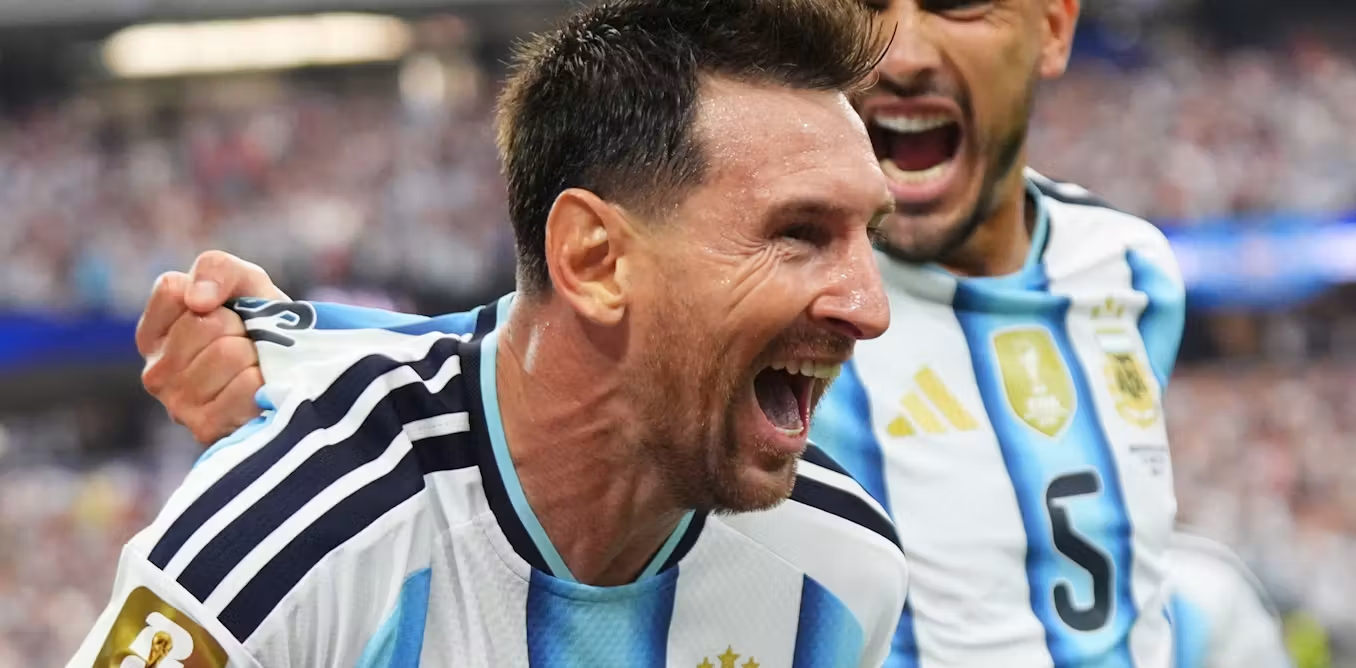
Lionel Messi is 39 years old. He is 1.70 metres tall – shorter than almost every defender he plays against. He was never astoundingly quick, and he is slower now.
And yet, watching this World Cup, you would be hard pressed to name a player doing more damage: he has scored the equal most goals so far (six), alongside France’s Kylian Mbappé.
How can someone with so little of what we might call athleticism (relative to his peers, at least) still be the best player on the pitch?
Does athleticism really matter?
Maybe the puzzle is the wrong way round. Many are surprised by Messi only because we have been told a story about what makes an athlete great, and the story is mostly about the body: speed, height, strength, fitness.
Measured against that story, Messi looks like an exception.
Read more:
World Cup: what’s just the right height for a soccer player?
But what if the story itself is the problem? What if soccer was never a contest of physical attributes?
Johan Cruyff, the great Dutch player, manager, commentator and soccer philosopher, saw this clearly half a century ago. He said:
What is speed? The sports press often confuses speed with insight. If I start running slightly earlier than someone else, I seem faster.
It is a remark that sounds like a riddle, but a fast player is often not the one with quicker legs. They are often the ones who set off sooner and arrive first. What looks like speed is very often a head start bought by perception.
Cruyff understood this. What we have been able to do more recently is measure it.
The importance of scanning
Consider what happens in the seconds before Messi receives a pass. Watch him for 30 seconds when the ball is nowhere near him: his head rarely stays still. One glance over the left shoulder, another to the right, then back to the player on the ball.
None of it looks remarkable until you realise he has already gathered information others are yet to find, or at least are less adept at finding.
By the time the ball reaches him, he already knows where the defenders and teammates are, and where the gaps will open. The control, the turn, the pass that splits the defence: all of that is the easy part. The hard part happens before he had even touched the ball.
This is something we can measure.
For more than a decade, we have been studying how soccer players gather information before receiving the ball. Working with athletes from youth academies up to senior professionals, we fitted small motion sensors to the backs of their heads, and recorded how often and how widely they turned to look around during a match.
We were measuring what we call visual exploration – or, more plainly, scanning.
We were asking a simple question: how much do players look around before the ball reaches them, and does it matter?
The finding was consistent and clear. Players who scanned more frequently in the seconds before receiving the ball were faster to release their next pass, more likely to turn with the ball rather than play it safely backwards, and more likely to play a forward pass that actually threatened the opposition.
The information they gathered before the ball arrived shaped what they were able to do once it did. Scanning is how a player gets that information in the first place.
Our work separates two purposes of scanning. The first is orientation: looking around to discover what the whole field is offering, which options exist, where the danger is and what might become available.
The second is specification: the finer, later looking that guides the execution of a pass.
Orientation comes first and it is the one we tend to neglect, in research and in coaching alike, because it happens away from the ball, when nothing dramatic appears to be going on. Yet it is the foundation. You cannot aim a pass you never saw was there. Cruyff put it like this:
There is only one moment in which you can arrive in time. If you are not there, you are either too early or too late.
This is where Messi stops being an anomaly and becomes the clearest example imaginable of what the sport rewards. He has never beaten opponents primarily with his body. He beats them with time, and he wins it by seeing sooner.
If he is slower, it does not matter, because he is not racing anyone – he has arranged, through earlier and better perception, never to need to. The shorter, slower, ageing body is not a handicap he overcomes through genius. It is a sign that the body was never the main event.
The skill you can build
Of course, scanning is not the whole story. Technique, experience and team tactics all matter. But without timely information, those qualities rarely have the chance to express themselves.
There is a lesson in this: perception is something we can develop, deliberately, in players who will never be the quickest or the tallest.
Coaches already sense this when they shout “check your shoulder” at a player about to turn into trouble or lose track of an opposing player.
Our data suggest the habit of scanning the field before the ball arrives can be trained from a young age.
Read more:
World Cup: why are left-footers like Messi so valuable in soccer?
Where greatness really lives
We have spent a century building athletes in the gym, but far less time building the thing Messi does in abundance.
So the next time someone wonders how a 39-year-old, standing just 1.70m tall, is still dominating a World Cup, watch their head, not their feet.
Greatness was never hiding in the body. It was always in the looking.

