

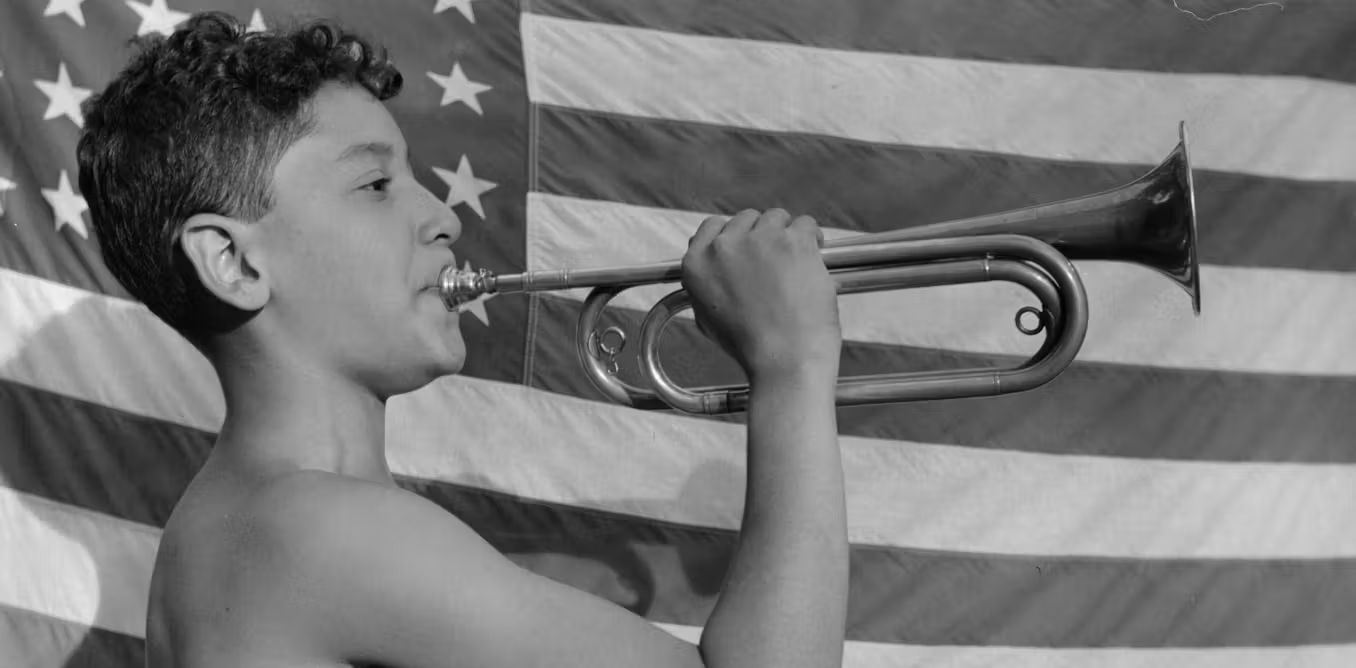
Imagine tall trees across the lake, a calm breeze, children laughing in the distance, the scent of your old canvas tent – there’s no forgetting the sights, sounds, smells and feel of summer camp.
Even if you’ve never gone to an overnight summer camp, you can still conjure visions of these iconic American outdoor places, thanks to books like “Otherwise Known as Sheila the Great,” TV shows like “Salute Your Shorts,” and films like “Wet Hot American Summer,” “Friday the 13th” and “The Parent Trap.”
However, popular culture can’t fully explain why summer camps hold such a nostalgic and almost obsessive place in the nation’s collective consciousness.
For many, attending summer camp is a rite of passage. But these camps originally arose to address a deeper anxiety held by parents, leaders and reformers, who worried about the character development of children and sought to use these places as training grounds for good American citizens.
One of us, Seth, currently works as a summer camp director. But we’re both scholars of geography who see summer camps as important educational spaces outside the traditional classroom. At camp, young people practice living with others, encounter people from different backgrounds and create community together.
At a time when Americans disagree deeply over the meaning of citizenship, belonging and education, summer camps remain places where values and visions of America as inclusive or exclusive are communicated to young people.
From urban refuge to national ritual
American summer camps date back to the mid-19th century. The first organized one is often attributed to educator and outdoorsman Frederick W. Gunn, who founded The Gunnery Camp in Washington, Connecticut, in 1861. There, boys were encouraged to march, fight, hunt, forage and live in the outdoors like soldiers.
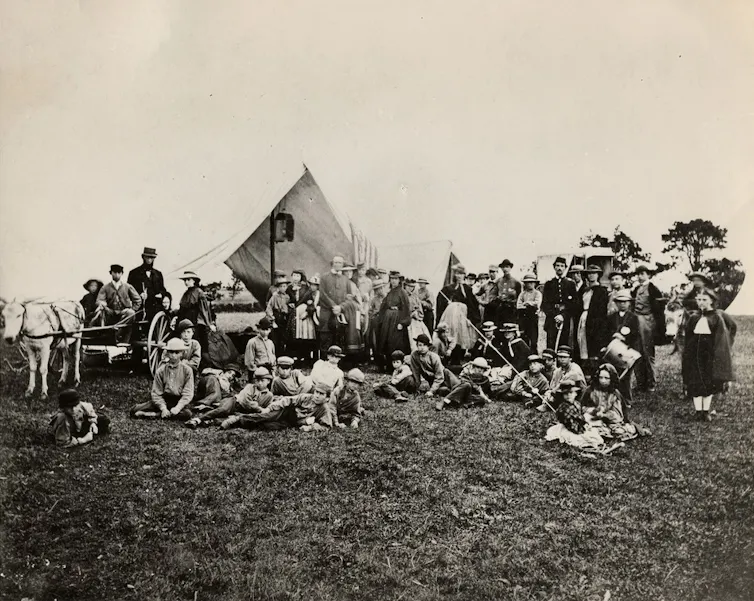
Letters from Charley Goodyear/Wikimedia Commons
Other summer camps soon planted flags of their own. In 1874, the Young Women’s Christian Association hosted its first summer camp in New Jersey, with other youth organizations such as the YMCA, the Boys Club and 4-H, a federal youth development program, following suit.
With more and more families settling in cities in the second half of the 19th century, camps gave kids a refuge from the oppressive heat, rancid smells and grinding noise of summer in the city.
“Muscular Christianity” also rose to prominence during this period. Its proponents championed a masculine vision of faith that emphasized physical discipline, character-building and experiencing the rugged outdoors. Embraced by prominent figures, such as President Theodore Roosevelt, the movement helped shape the philosophy of early American summer camps.
The summer camp scene really began to take off in the early 20th century. The establishment of the Boy Scouts of America and the Girl Scouts of the USA in 1910 and 1912, respectively, added to the growing list of camps available for American youth.
Summer camps declined in the 1940s due to World War II, but they bounced back stronger than ever in the 1950s, ’60s and ’70s, especially as membership surged in youth organizations, such as the Boy Scouts of America.
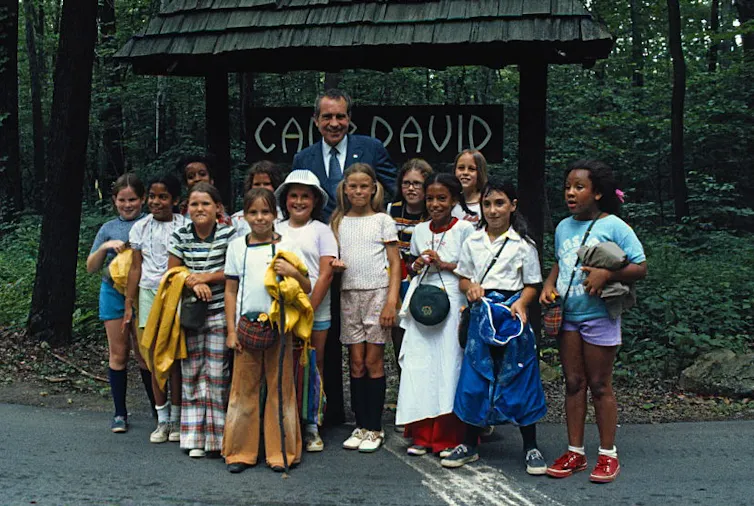
Bettmann/Getty Images
Since then, however, the number of kids in these youth organizations has decreased. The reasons include competition from year-round youth sports competitions, scandals involving youth organizations, including the Boy Scouts, and the rising costs of attending camps.
Camp as character development
Despite their dip in popularity over the past few decades, summer camps continue to have a significant economic and cultural impact.
According to a Gallup poll, roughly 30 million American youth attended summer enrichment programs in 2024, which includes day camps, summer schools and sleepaway camps. The American Camp Association has found that the youth camp industry contributes US$70 billion annually to the U.S. economy.
Amid classic activities, including swimming, hiking and craft-making, summer camps have long played a larger role as a nationalistic ritual. Flag lowering and raising ceremonies, reciting the Pledge of Allegiance and the singing of patriotic songs remain mainstays at many summer camps today. At camp, children often learn about patriotism, discipline, cooperation, leadership and self-reliance.
At Canyon Camp, a Scouting America summer camp in Northwest Illinois, Scouts have the opportunity to earn merit badges such as “American Heritage,” which can involve learning the racial and ethnic history of your hometown, and “Citizenship in the Nation,” which involves learning about the three branches of government.
During summer 2026, campers can also earn a special America 250 challenge patch by completing tasks such as giving a speech on “one right I won’t take for granted” and virtually visiting a historic site from America’s founding era.
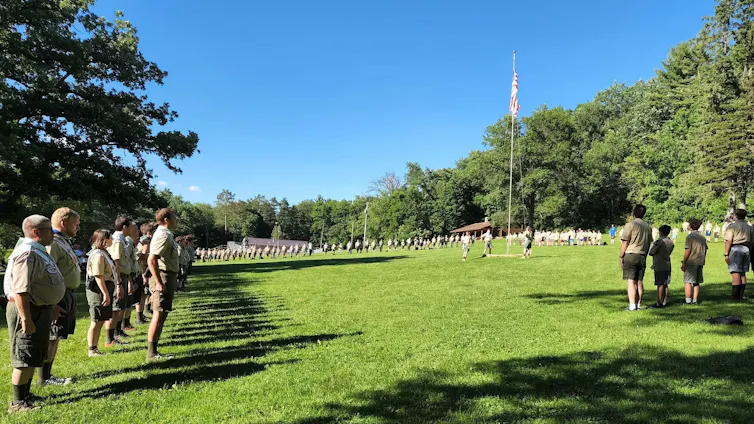
Canyon Camp
Who gets to be a camper
Summer camps – and the ideals they communicated – were never neutral. Race, class and gender have historically shaped who was welcomed.
The summer camps of the late 19th and early 20th centuries were primarily for white, Protestant, middle- and upper-class boys from Northeastern cities. The summer camp movement gradually expanded to include different regions, classes, faiths and genders. For example, the first Jewish summer camps emerged in upstate New York at the turn of the 20th century; they sought to assimilate campers into American life and encourage civic participation.
Similarly, Black communities formed summer camps during the Jim Crow era, such as Camp Atwater in Massachusetts, to provide a refuge from segregation and racism, promote racial pride and give kids the opportunity to develop leadership skills.
Interracial summer camps, while not widespread, did start to crop up in the mid-20th century. In 1943, Black photographer Gordon Parks documented two of those summer camps – Camp Nathan Hale and Camp Gaylord White – in New York state. His images of Black and white children playing, eating, working and raising the American flag together showed how summer camp could promote a new set of national values.

Gordon Parks/Heritage Images via Getty Images
But camps proved slow to racially integrate, even after the monumental civil rights victories of the 1960s. In 1965, when the American Camping Association adopted a nondiscriminatory, interracial policy, 125 members resigned in opposition. Southern 4-H programs, even while receiving funds from the federal government, hesitated to desegregate their camps during this period.
A summer camp divide still exists. A 2024 Gallup poll found that Black, Asian and low-income children are less likely to participate in summer camps. Additionally, 32% of parents shared that their children did not attend summer camp due to cost considerations. To this end, children from wealthy families are overrepresented.
Camp and the culture wars
Today’s summer camps are not all explicitly nationalistic, nor do they all teach the same values. Scout camps, faith-based camps, camps for LGBTQ kids and camps for children with physical or mental disabilities differ in their missions.
What unites them is the belief that camps can help mold character and instill the values children will carry into adulthood. Yet these values have become contested terrain in recent years.
When Defense Secretary Pete Hegseth demanded that Scouting America – formerly Boy Scouts of America – shed all diversity, equity and inclusion practices and redouble its efforts as an organization that “develops boys into men,” he underscored how even seemingly apolitical institutions have become battlegrounds in America’s culture wars.
Despite the fact that young women and girls had been welcomed into the organization since 2019, Hegseth seemed to want to restore an older view of Scouting and summer camps, one centered on masculine ideals of ruggedness, individuality and muscular nationalism.
To us, this rhetoric is not simply an innocent expression of nostalgia. It seeks to define what it means to be a good American and a good citizen – and who should be included in this vision.
As the summer season continues and the nation will soon celebrate it’s 250th birthday, we think it’s a fitting time to reflect on the role that summer camp plays in reinforcing ideals of what it means to be an American and which values ought to be promoted – and we believe this matters more than ever in 2026.

