

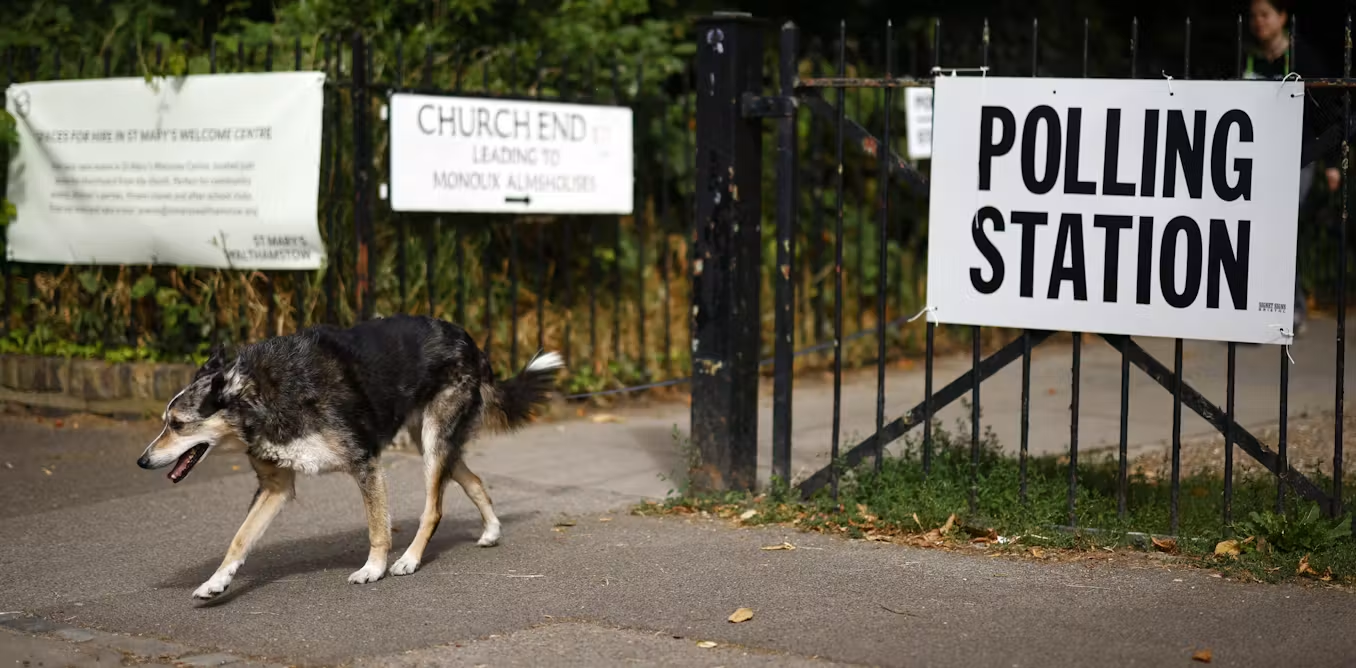
Keir Starmer’s departure as prime minister will not automatically trigger a general election, despite a clamour from some opposition politicians. But voters do not need to be involved in the selection of his successor because of how the UK political system operates: the Labour party won a five-year mandate in July 2024. The main question right now is whether there will even be a contest within Labour to choose its new leader and the UK’s next prime minister.
The UK is a parliamentary democracy. Westminster elections are held at least every five years, and governments are generally formed by the party – or coalition of parties – that has a majority of MPs in the House of Commons. By convention and political necessity, the monarch appoints the leader of the majority party to be prime minister. When there has been no majority party, the monarch has usually invited the leader of the largest party to form a government.
For so long as it has a majority, the governing party forms the government regardless of who leads it. Opposition politicians know this, even if they tend to call for a general election whenever the governing party changes its leader. One consideration may suppress such calls on this occasion – the poll ratings of the traditional parties (especially the Conservatives and Liberal Democrats). Only Reform UK would stand to benefit from a snap election.
Read more:
Andy Burnham: what to expect from the UK’s likely next prime minister
It follows from all this that there are two main routes to becoming prime minister in the UK. The first is to be selected as the leader of the opposition and then win a majority of seats at a general election. The second route is to be selected as the new leader of an already incumbent governing party and become a “takeover” prime minister midway thought a parliament.
Among postwar prime ministers, nine initially took office through the first route – that is, by winning a general election and causing a change in the party of government. Labour’s Harold Wilson achieved this feat twice, in 1964 (he lost to Edward Heath’s Conservatives in 1970), and again in 1974.
Starmer was the most recent new prime minster to take office in this way, in 2024 when Labour overturned the Conservatives’ majority and won 411 of the 650 available seats.
In contrast, ten people – soon to be 11 – took office midway through a parliament by being selected as the governing party’s new leader. The most recent was Rishi Sunak, Starmer’s immediate predecessor. Sunak was an unusual “double” takeover prime minister: he took office after the Conservatives ejected two prime ministers – Boris Johnson and Liz Truss – in quick succession.
Wanting a general election
Every takeover prime minster would like to win a general election of their own. It helps them to establish their authority and credibility, it lays to rest opposition jibes about their legitimacy, and it removes the political shackles of inherited manifesto pledges.
Of the ten postwar takeover prime ministers to date, only one – the Conservative Anthony Eden in 1955 – managed the trick of immediately calling and winning a general election. Four others – fellow Conservatives Harold Macmillan, John Major and Boris Johnson – waited before facing voters but still won a majority of their own.
Theresa May’s “victory” (the Conservatives just fell short of a majority) in 2017 saw her returned at the head of a minority government. This effectively left her “a dead woman walking”. The remaining five takeover prime ministers lost office when facing voters for the first time.
Wanting a ‘coronation’
There won’t be a general election now because Labour has another three years before it must face voters and, more importantly, it is way behind in the polls. It would be political madness for Starmer’s successor to call an early vote. The more pressing question is whether there will even be an internal party leadership contest.
Some in the Labour party would prefer an uncontested coronation for Andy Burnham, the former mayor of Greater Manchester, whose resounding win in the Makerfield byelection precipitated Starmer’s resignation. Those backing this route argue that it would spare the party a divisive and distracting contest.
The counter-argument is that not having a contest risks saddling the party with an untested leader who may lack the skills and vision needed to be prime minister. The absence of a contest also risks stifling debate and may cost the new leader the legitimacy and “leadership capital” that comes from winning an internal leadership election.
What happens next will depend on the calculations of Labour MPs. Starmer’s resignation speech set out a clear timetable for choosing a new leader. Nominations will open on July 9 and will close a week later. Those fancying their chances must be a Labour MP and will need to secure the backing of 81 colleagues plus other parts of the party, including constituency parties or affiliated trade unions. Burnham’s nomination looks assured. So far, that is not the case for anyone else.
But people might want to be careful what they wish for. If Burnham succeeds Starmer, he will rapidly find that the reality of governing is far more difficult than positioning to be a potential successor. The country’s economic outlook remains bleak, yet expectations among Labour MPs and supporters are potentially greater.
Perhaps more ominously, Labour has shown it is willing to commit regicide. It should not be forgotten, amid everything else, that Keir Starmer has become the first Labour prime minister to be forced from office through an anticipated leadership contest. As the Conservatives discovered after Brexit, the habit of regicide, once acquired, is not easily lost.

