

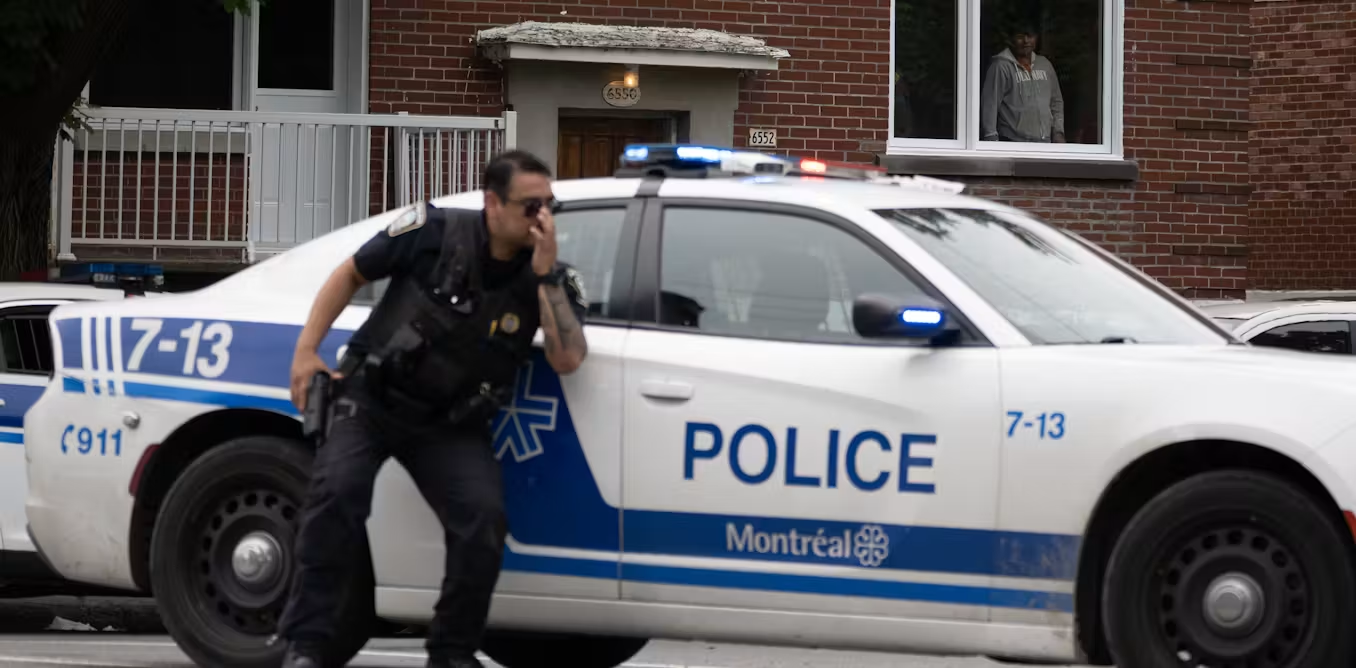
The horrific details surrounding the shootout in Montréal, which left three dead, are coming to light as officials are sharing more information.
Mohamed Lamine Benredouane, a member of the city’s police force since 2021, was killed while engaging with the suspect. Benredouane leaves behind his pregnant wife and a young child, and his loss is felt in the policing community and beyond.
Michael Mizrahi, a beloved member of his community, was identified as the civilian killed in the shootout.
An act of terrorism?

THE CANADIAN PRESS/Jacques Boissinot
Ian Lafrenière, Québec’s domestic safety minister, said just hours after the shooting that it wasn’t linked to terrorism.
This statement is troubling not just because it was made prematurely, in the early stages of the investigation, but also because it contradicted media reporting that outlines the shooter’s grievances in a manifesto linked to the “involuntary celibacy” or “incel” movement. There is growing evidence of an ideological dimension to the shooting.
Read more:
If misogyny was a factor, is Toronto rampage a terrorist act against women?
Media accounts of the manifesto detail how the shooter’s grievances used incel rhetoric, arguing for the erosion of women’s rights and freedoms, and takes specific aim at liberalism as a source of male suffering.
The disturbing details of the manifesto advocate for a return to traditional values and call for a new social order.
The shooter, from Lethbridge, Alta., engaged in this senseless act of violence in the same city where the École Polytechnique massacre took place almost three decades earlier.
Young radicalized men
The radicalization of young men with digital sexist content is a growing public safety concern that has real-world implications.
Lost in the media reporting is that the shooter was wearing attire eerily reminiscent of Rhodesian brushstroke, a camouflage pattern linked to contemporary white supremacism’s romanticized view of Rhodesia. It’s unclear whether the shooter held white supremacist beliefs, but the choice of uniform is concerning.
The shooting shouldn’t be considered an isolated incident. Instead, it’s indicative of a growing pattern of violence perpetrated by young men who hold misogynistic or racist world views.

THE CANADIAN PRESS/Christopher Katsarov
A troubling pattern
There is a longstanding history of violence perpetrated by radicalized young men whose motivations have varied across a range of different grievances. These incidents have resulted in the deaths and injuries of police officers and members of the public.
In 2014, three Mounties were killed, and two more were injured, in an ambush targeting police officers in Moncton, N.B. The shooter, wearing camouflage and armed with a long gun, held a range of anti-government beliefs characterized by feelings of oppression.
In 2017, a gunman opened fire on the Québec Islamic Cultural Centre and killed six worshippers and injured several others. Long known to feminists and refugee support groups as in internet troll, the shooter was motivated by Canada’s immigration policies.
Read more:
A year later: The mosque massacre & rising Islamophobia
A terrorist attack against the Afzaal family in London, Ont., in 2021 by a white nationalist was motivated by Islamophobia and anti-Muslim hatred. The suspect indicated to police he was looking for Muslims to kill and wrote a manifesto outlining his white supremacist beliefs.

THE CANADIAN PRESS/Nathan Denette
Two brothers, motivated by anti-government sentiment and Canada’s firearm laws, staged a bank robbery in Saanich, B.C., to engage police in a gunfight in 2022. Six officers of the Greater Victoria Emergency Response Team were wounded in the ensuing gunfight.
Most recently, the RCMP disrupted a terrorist plot last summer involving a group of four men who sought to form an anti-government militia and seize land in Québec.
These Canadian cases are a just a segment of a global snapshot of a much broader epidemic of violence targeting women, the LGBTQ2S+ community, religious and ethnic minorities and police across many western liberal democracies. This violence often stems from online rhetoric before translating into acts of physical violence and hate.
Downplaying a growing threat
While the incel movement has been identified as a public safety threat and has been prosecuted in the courts, the threat of white nationalism in Canada poses a similar threat to public safety.
White nationalist and neo-Nazi groups have been preparing for a “race war” and actively use digital media to recruit to their growing following.
This recruiting strategy involves targeting vulnerable young men and normalizing their public outreach in a manner akin to the Ku Klux Klan. Like the Klan, a group called the Second Sons uses the imagery of white masks to stage anti-immigration demonstrations across Canada.
Police services have downplayed the threat posed by these organizations, distinguishing between offensive speech and criminal conduct.
This is not a unique finding — both the asymmetric policing of white supremacist organizations and the framing of terrorism as a non-white issue highlight the deeply racialized dimensions of modern law enforcement.
THE CANADIAN PRESS/Andrew Vaughan
While police services emphasize the threat of religious extremism, they simultaneously identify other groups as being more criminally active. A case study into the police contacts of Gabriel Wortman, the perpetrator of the 2020 Nova Scotia mass shooting, illustrates how various institutional biases maintain racial disparities in policing and impede public safety.
While Wortman wasn’t motivated by religious or racist ideology, his socioeconomic and racial privilege shielded him from more serious investigation — a form of insulation that mirrors how white supremacist organizations are policed.
How to prevent the next tragedy
Both incel and white nationalist movements recruit vulnerable young men using propaganda that blames societal problems on the expansion of rights for women and marginalized groups.
Because this rhetoric easily translates into violence against law enforcement and the public, these organizations must be treated as serious threats to public safety.
While security and intelligence agencies must work to disrupt these hate-filled sub-cultures, this isn’t a problem that can simply be policed away. Countering violent extremism requires substantial investment from all levels of government, dismantling the state’s racialized assumptions of criminality and recognizing that gendered violence is systemic.

