

On Earth, garnet is best known as the fiery red January birthstone — popular in jewellery since the Bronze Age and valued highly by ancient Egyptians.
Our team has now discovered a new rock type containing the mineral garnet inside a meteorite fragment from the planet Mars.
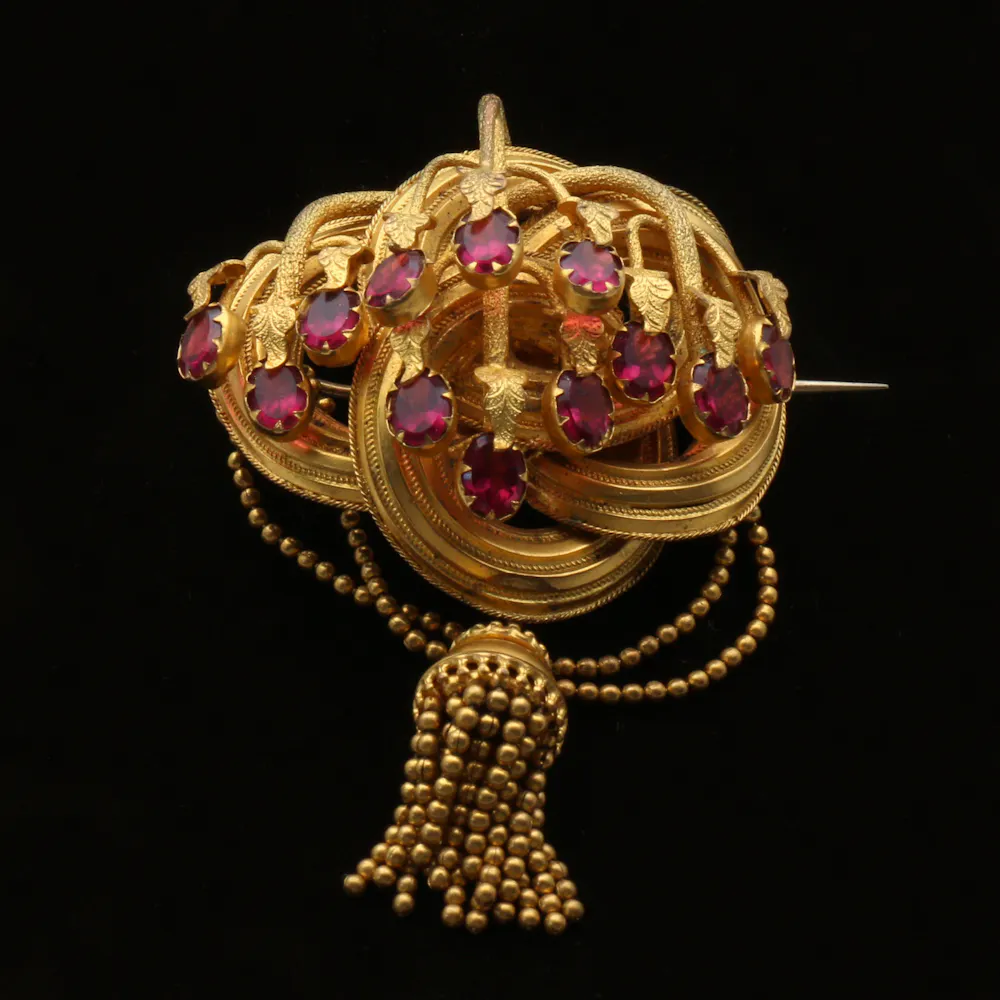
(Charles J. Sharp), CC BY-SA
While garnet is common on Earth, we have previously only speculated about its existence in Mars’s interior and found rare, minute inclusions in Martian meteorites that formed during their ejection from the planet.
This is the first time the mineral has been identified within a rock that potentially formed within the crust of Mars itself.
As a planetary scientist and geologist, my main goal is to study the chemical and mineral makeup of rocks on Mars to help piece together the planet’s complex history. Our discovery of a new garnet-rich rock type is a significant step towards that goal.
Minerals preserve history
Mars has been the target of numerous exploration missions since the 1960s by satellites, landers and rovers.
While the search for signs of past life has driven these efforts, it is the inorganic components of Mars — its rocks and minerals — that preserve the record of the planet’s 4.5 billion-year history.
Minerals and rocks are produced by complex interactions among the geosphere, atmosphere, hydrosphere and even the influence of life. Detailed analyses of newly discovered rocks and minerals can help us understand how a planet’s geological processes, climate and resulting habitability potential have evolved over time.
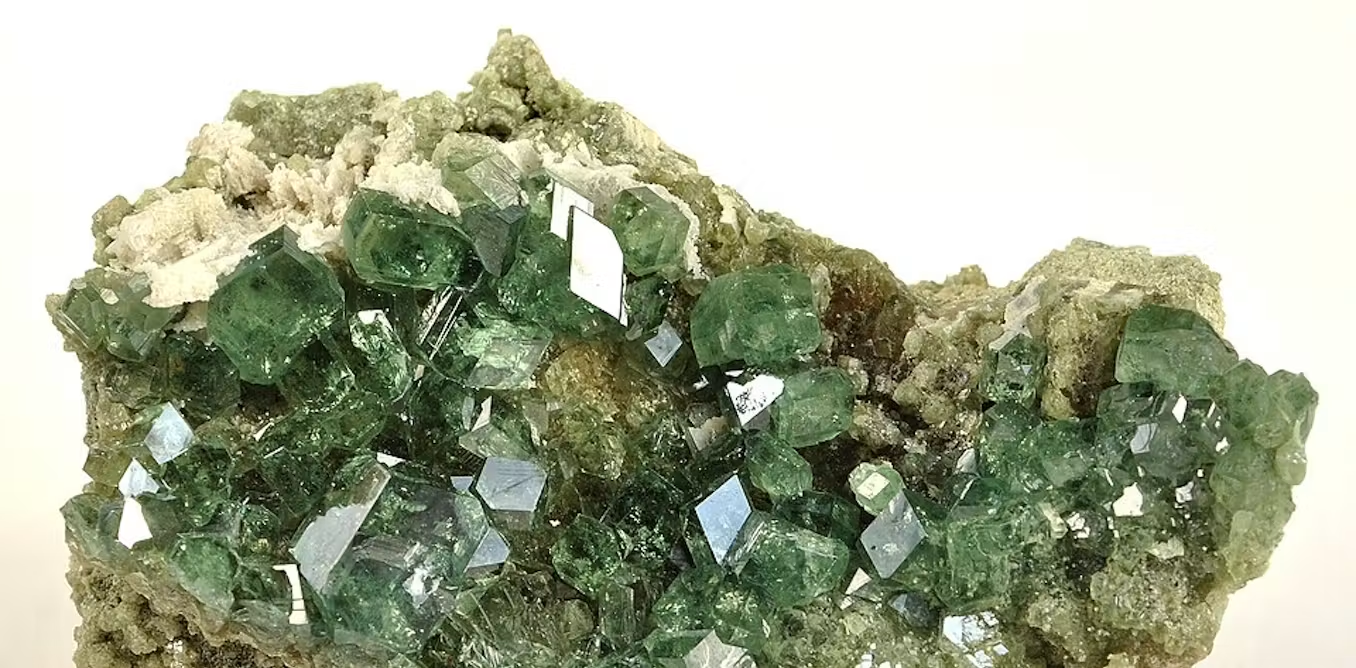
An andradite garnet

(Rob Lavinsky), CC BY-SA
Garnets are a group of minerals with the same crystal structure and a range of chemical compositions. Some of the most common species within this group include almandine and pyrope (the deep-red January birthstone gems), andradite and grossular.
The rock we have identified contains garnet of the andradite variety. It can come in many colours, but is often yellow or green.
It, too, has been used as a gemstone, sometimes called “demantoid.”
Metamorphic environments
On Earth, andradite garnets commonly occur in metamorphic rocks called skarns that have been transformed due to intense heat and reaction with fluids.
Metamorphic environments on Earth are widespread and varied due to active plate tectonics, which have subjected rocks to extreme pressures and temperatures through mountain-building events and plate subduction.
Mars, on the other hand, lacks plate tectonics and as such, the extent and nature of Martian metamorphism remains speculative and limited.
The garnet-bearing clast (rock fragment) we found may represent a previously unknown metamorphic process on Mars, challenging our current view of the range of geological environments possible on the red planet. It could also have formed in a new type of igneous rock, formed from lava or magma, that we have never seen on Mars before.
However, while these are exciting implications, many uncertainties still remain about the garnet’s origin and formation.

(Tanya Kizovski), Author provided (no reuse)
Ancient meteorite impact
The meteorite that contains the andradite garnet is known as NWA 8171, and was found in the Sahara desert in Northwest Africa (NWA) in 2013.
Several pieces of this meteorite are now held in the Royal Ontario Museum’s collection, including the piece we analyzed. NWA 8171 is one of 18 Martian meteorite pieces that are all paired to the same meteorite fall. The most famous is NWA 7034, informally known as “Black Beauty.”
The 18 paired fragments are confirmed to be from Mars because trapped noble gas compositions within them match the Martian atmosphere, and their mineral chemistry, and bulk oxygen isotope compositions also match Martian values. Oxygen isotopes signatures act as distinct fingerprints for planets and asteroids and are often used to determine planetary parentage.
NWA 8171 also belongs to a class of meteorites called “Martian polymict regolith breccia meteorites.” Essentially, these meteorites are made of a variety of rocks that were broken up and re-assembled together on the surface, or near-surface, of Mars by ancient meteorite impact events.
Possible Martian origin
While NWA 8171 is confirmed to have originated from Mars, determining if the garnet-bearing fragment also formed on Mars is more complex.
Evidence for a Martian origin is strong and includes:
1) The chemistry of pyroxene grains intergrown with garnet closely match typical Martian values. While not as definitive as oxygen isotopes, pyroxene chemistry is often used as a marker of planetary parentage.
2) The textures and mineralogy of the garnet-bearing fragment are relatively similar to others observed in NWA 8171.
3) The fragment is embedded in a Martian meteorite. This may be a bit obvious, but is a strong point that should not be understated.
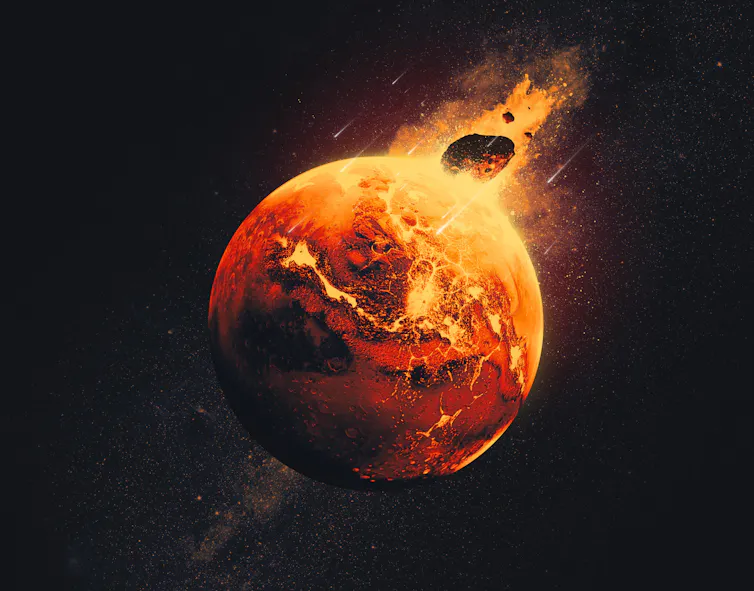
(NASA/JPL-Caltech)
Possible exotic meteorites
However, as discussed above, NWA 8171 is comprised of a variety of rock components likely assembled on the surface, or near to the surface, of ancient Mars by meteorite impacts. Some of these components could technically include preserved fragments of exotic “extraMartian” meteorites from elsewhere.
Due to these complexities and the novelty of this garnet-rich rock type, we will likely need to measure oxygen isotopes within the fragment itself to confirm its origin. This type of analysis is destructive and has been avoided while other studies are ongoing.
Regardless of its origin, the discovery of garnet in this meteorite sample will provide us with new insights into geologic processes on Mars, and/or meteorite impacts and delivery in the inner Solar System.

